Pages

St Benedict on Tuesday (Rogation Day) - May readings

You may recall that my previous posts on the old votive Office of St Benedict, usually said on the first free Tuesday of each month.

This Tuesday is, of course, also a rogation day, but my 1892 Monastic breviary prescribes that instead of the rogation day office, the Office of St Benedict be said on this day 'with a commemoration of the cross only'.

Accordingly, the readings for the votive office are set out below.

Reading 1: From the Third Book of Kings, chapter 17 - The son of the woman, the mistress of the house, fell sick, and the sickness was very grievous, so that there was no breath left in him. And she said to Elias: What have I to do with thee, thou man of God? art thou come to me that my iniquities should be remembered, and that thou shouldst kill my son? And Elias said to her: Give me thy son. And he took him out of her bosom, and carried him into the upper chamber where he abode, and laid him upon his own bed. And he cried to the Lord, and said: O Lord my God, hast thou afflicted also the widow, with whom I am after a sort maintained, so as to kill her son? And he stretched, and measured himself upon the child three times, and cried to the Lord, and said: O Lord my God, let the soul of this child, I beseech thee, return into his body. And the Lord heard the voice of Elias: and the soul of the child returned into him, and he revived. And Elias took the child, and brought him down from the upper chamber to the house below, and delivered him to his mother, and said to her: Behold thy son liveth. And the woman said to Elias: Now, by this I know that thou art a man of God, and the word of the Lord in thy mouth is true.

R. Honestum fecit illum Dóminus, et custodívit eum ab inimícis, et a seductoribus tutavit illum: * Et dedit illi claritátem ætérnam.
V. Justum dedúxit Dóminus per vias rectas, et osténdit illi regnum Dei
R. Et dedit illi claritátem ætérnam.
R. The Lord made him honourable, and defended him from his enemies, and kept him safe from those that lay in wait for him; * And gave him perpetual glory.
V. He went down with him into the pit, and left him not in bonds.
R. And gave him perpetual glory.

Reading 2: From Chapter 11 of the Dialogues of  St Gregory the Great - Again, as the monks were making of a certain wall somewhat higher, because that was requisite, the man of God in the meantime was in his cell at his prayers. To whom the old enemy appeared in an insulting manner, telling him, that he was now going to his monks, that were a-working: whereof the man of God, in all haste, gave them warning, wishing them to look unto themselves, because the devil was at that time coming amongst them. The message was scarce delivered, when as the wicked spirit overthrew the new wall which they were a building, and with the fall slew a little young child, a monk, who was the son of a certain courtier.  At which pitiful chance all were passing sorry and exceedingly grieved, not so much for the loss of the wall, as for the death of their brother: and in all haste they sent this heavy news to the venerable man Benedict;

R. Amávit eum Dóminus, et ornávit eum: stolam glóriæ induit eum, * Et ad portas paradisi coronávit eum.
V. Induit eum Dóminus lorícam fidei, et ornávit eum.
R. Et ad portas paradisi coronávit eum.
R. The Lord loved him and beautified him He clothed him with a robe of glory * And crowned him at the gates of Paradise.
V. The Lord hath put on him the breast-plate of faith, and hath adorned him.
R. And crowned him at the gates of Paradise.

Reading 3: Who commanded them to bring unto him the young boy, mangled and maimed as he was, which they did, but yet they could not carry him any otherwise than in a sack: for the stones of the wall had not only broken his limbs, but also his very bones. Being in that manner brought unto the man of God, he bad them to lay him in his cell, and in that place upon which he used to pray; and then, putting them all forth, he shut the door, and fell more instantly to his prayers than he used at other times. And O strange miracle! for the very same hour he made him sound, and as lively as ever he was before; and sent him again to his former work, that he also might help the monks to make an end of that wall, of whose death the old serpent thought he should have insulted over Benedict, and greatly triumphed.

R. Iste homo perfécit ómnia quæ locútus est ei Deus, et dixit ad eum: Ingredere in réquiem meam: * Quia te vidi justum coram me ex ómnibus géntibus.
V. Iste est qui contempsit vitam mundi, et pervénit ad cæléstia regna.
R. Quia te vidi justum coram me ex ómnibus géntibus.
V. Glória Patri, et Fílio, * et Spirítui Sancto.
R. Quia te vidi justum coram me ex ómnibus géntibus.
R. This is he which did according unto all that God commanded him; and God said unto him: Enter thou into My rest, * For thee have I seen righteous before Me among all people.
V. This is he which loved not his life in this world, and is come unto an everlasting kingdom.
R. For thee have I seen righteous before Me among all people.
V. Glory be to the Father, and to the Son, * and to the Holy Ghost.
R. For thee have I seen righteous before Me among all people.

St Augustine on lectio divina

Commentary on Psalm 89:

This Psalm is entitled, The prayer of Moses the man of God, through whom, His man, God gave the law to His people, through whom He freed them from the house of slavery, and led them forty years through the wilderness. Moses was therefore the Minister of the Old, and the Prophet of the New Testament. For all these things, says the Apostle, happened unto them for ensamples: and they are written for our admonition, unto whom the ends of the world come. 1 Corinthians 10:11 In accordance therefore with this dispensation which was vouchsafed to Moses, this Psalm is to be examined, as it has received its title from his prayer

On Psalm 36

I have been young, and now am old; yet have I not seen the righteous forsaken, nor his seed begging bread Psalm 36:25.

If it is spoken but in the person of one single individual, how long is the whole life of one man? And what is there wonderful in the circumstance, that a single man, fixed in some one part of the earth, should not, throughout the whole space of his life, being so short as man's life is, have ever seen the righteous forsaken, nor his seed begging bread, although he may have advanced from youth to age. It is not anything worthy of marvel; for it might have happened, that before his lifetime there should have been some righteous man seeking bread; it might have happened, that there had been some one in some other part of the earth not where he himself was. Hear too another thing, which makes an impression upon us. Any single one among you (look you) who has now grown old, may perhaps, when, looking back upon the past course of his life, he turns over in his thoughts the persons whom he has known, not find any instance of a righteous man begging bread, or of his seed begging bread, suggest itself to him; but nevertheless he turns to the inspired Scriptures, and finds that righteous Abraham was straitened, and suffered hunger in his own country, and left that land for another; he finds too that the son of the very same man, Isaac, removed to other countries in search of bread, for the same cause of hunger. And how will it be true to say, I have never seen the righteous forsaken, nor his seed begging bread? And if he finds this true in the duration of his own life, he finds it is otherwise in the inspired writings, which are more trustworthy than human life is.

2. What are we to do then? Let us be seconded by your pious attention, so that we may discern the purpose of God in these verses of the Psalm, what it is He would have us understand by them. For there is a fear, lest any unstable person, not capable of understanding the Scriptures spiritually, should appeal to human instances, and should observe the virtuous servants of God to be sometimes in some necessity, and in want, so as to be compelled to beg bread: should particularly call to mind the Apostle Paul, who says, In hunger and thirst; in cold and nakedness; 2 Corinthians 11:27 and should stumble thereat, saying to himself, Is that certainly true which I have been singing? Is that certainly true, which I have been sounding forth in so devout a voice, standing in church? 'I have never seen the righteous forsaken, nor his seed begging bread.' Lest he should say in his heart, Scripture deceives us; and all his limbs should be paralyzed to good works: and when those limbs within him, those limbs of the inner man, shall have been paralyzed (which is the more fearful paralysis), he should henceforth leave off from good works, and say to himself, Wherefore do I do good works? Wherefore do I break my bread to the hungry, and clothe the naked, and take home to mine house him who has no shelter, Isaiah 58:7 putting faith in that which is written? 'I have never seen the righteous forsaken, nor his seed begging bread;' whereas I see so many persons who live virtuously, yet for the most part suffering from hunger. But if perhaps I am in error in thinking the man who is living well, and the man who is living ill, to be both of them living well, and if God knows him to be otherwise; that is, knows him, whom I think just, to be unjust, what am I to make of Abraham's case, who is commended by Scripture itself as a righteous person? What am I to make of the Apostle Paul, who says, 'Be followers of me, even as I also am of Christ.' 1 Corinthians 11:1 What? That I should myself be in evils such as he endured, 'In hunger and thirst, in cold and nakedness'? 2 Corinthians 11:27

3. Whilst therefore he thus thinks, and while his limbs are paralyzed to the power of good works, can we, my brethren, as it were, lift up the sick of the palsy; and, as it were, lay open the roof of this Scripture, and let him down before the Lord. Luke 5:19 For you observe that it is obscure. If obscure therefore, it is covered. And I behold a certain patient paralytic in mind, and I see this roof, and am convinced that Christ is concealed beneath the roof. Let me, as far as I am able, do that which was praised in those who opened the roof, and let down the sick of the palsy before Christ; that He might say unto him, Son, be of good cheer, your sins be forgiven you. Luke 5:20 For it was so that He made the inner man whole of his palsy, by loosing his sins, by binding fast his faith....

4. But who is the righteous man, who has never been seen forsaken, nor his seed begging bread? If you understand what is meant by bread, you understand who is meant by him. For the bread is the Word of God, which never departs from the righteous man's mouth....See now if holy meditation does 'keep you' in the rumination of this bread, then have you never seen the righteous forsaken, nor his seed begging bread.

Readings for the Votive Office of St Benedict on Tuesday for October

You can find introductory notes on the old Votive Office of St Benedict here.  The texts for each of the hours can be found as follows:
The readings for Matins in October are set out below.

Reading 1: From the second book of Corinthians - If I must glory (it is not expedient indeed): but I will come to visions and revelations of the Lord. I know a man in Christ above fourteen years ago (whether in the body, I know not, or out of the body, I know not; God knoweth), such a one caught up to the third heaven. And I know such a man (whether in the body, or out of the body, I know not: God knoweth): That he was caught up into paradise, and heard secret words, which it is not granted to man to utter. For such an one I will glory; but for myself I will glory nothing, but in my infirmities. For though I should have a mind to glory, I shall not be foolish; for I will say the truth. But I forbear, lest any man should think of me above that which he seeth in me, or any thing he heareth from me. And lest the greatness of the revelations should exalt me, there was given me a sting of my flesh, an angel of Satan, to buffet me. For which thing thrice I besought the Lord, that it might depart from me. And he said to me: My grace is sufficient for thee: for power is made perfect in infirmity.

R: Sanctus Benedictus plus appetiit mala mundi  perpeti quam laudes pro Deo laboribus fatigari * Quam vitae hujus favoribus extolli
V: Divina namque praeventus gratia magis ac magis ad superna animo suspirabat
R: Quam vitae hujus favoribus extolli
R St Benedict desiring rather the miseries of the world than the praises of men: rather to be wearied with labor for God's sake * than to be exalted with transitory commendation
V: For filled greatly with divine grace, his soul aspired to even higher things
R: Than to be exalted with transitory commendation 

Reading 2: From the Dialogues of St Gregory the Great, Book II (ch 35) - The man of God, Benedict, |97 being diligent in watching, rose early up before the time of matins (his monks being yet at rest) and came to the window of his chamber, where he offered up his prayers to almighty God. Standing there, all on a sudden in the dead of the night, as he looked forth, he saw a light, which banished away the darkness of the night, and glittered with such brightness, that the light which did shine in the midst of darkness was far more clear than the light of the day. Upon this sight a marvellous strange thing followed, for, as himself did afterward report, the whole world, gathered as it were together under one beam of the sun, was presented before his eyes, and whiles the venerable father stood attentively beholding the brightness of that glittering light, he saw the soul of Germanus, Bishop of Capua, in a fiery globe to be carried up by Angels into heaven. Then, desirous to have some witness of this so notable a miracle, he called with a very loud voice Servandus the Deacon twice or thrice by his name, who, troubled at such an unusual crying out of the man of God, went up in all haste, and looking forth saw not anything else, but a little remnant of the light, but wondering at so great a miracle, the man of God told him all in order what he had seen, and sending by and by to the town of Cassino, he commanded the religious man Theoprobus to dispatch one that night to the city of Capua, to learn what was become of Germanus their Bishop: which being done, the messenger found that reverent Prelate departed this life, and enquiring curiously the time, he understood that he died at that very instant, in which the man of God beheld him ascending up to heaven.

R: O laudanda sancti Benedicti merita gloriosa qui dum pro Christo patriam mundique sprevit pompam adeptus omnium contubernium beatorum * Et particeps factus praemiorum aeternorum
V: Inter choros confessorum splendidum possidet locum ubi ipsum fontem omnium intuetur bonorum
R: Et particeps factus praemiorum aeternorum
O praise the glorious merits of St Benedict who for Christ left his fatherland and the pomp of the world, and arrived at the companionship of all the blessed * And was made a partaker of eternal rewards
 V: He holds a splendid place among the chorus of confessors, where he gazes upon the font of all good
R: And was made a partaker of eternal rewards

Reading 3: Assure yourself, Peter, of that which I speak: to wit, that all creatures be as it were nothing to that soul which beholdeth the Creator: for though it see but a glimpse of that light which is in the Creator, yet very small do all things seem that be created: for by means of that supernatural light, the capacity of the inward soul is enlarged, and is in God so extended, that it is far above the world: yea and the soul of him that seeth in this manner, is also above itself; for being rapt up in the light of God, it is inwardly in itself enlarged above itself, and when it is so exalted and looketh downward, then doth it comprehend how little all that is, which before in former baseness it could not comprehend. The man of God, therefore, who saw the fiery globe, and the Angels returning to heaven, out of all doubt could not see those things but in the light of God: what marvel, then, is it, if he saw the world gathered together before him, who, rapt up in the light of his soul, was at that time out of the world? But albeit we say that the world was gathered together before his eyes, yet were not heaven and earth drawn into any lesser room than they be of themselves, but the soul of the beholder was more enlarged, which, rapt in God, might without difficulty see that which is under God, and therefore in that light which appeared to his outward eyes, the inward light which was in his soul ravished the mind of the beholder to supernal things, and shewed him how small all earthly things were.

R: Sanctissime confessor Christi Benedicte monachorum pater et dux *  Intercede pro nostra omniumque salute
V: Devotae plebi subveni sancta intercessione ut tuis adjuta precibus regna caelestia consequatur
R: Intercede pro nostra omniumque salute
V: Gloria Patri...
V: Devotae plebi subveni sancta intercessione ut tuis adjuta precibus regna caelestia consequatur
R: O Benedict, Most holy confessor of Christ, father and leader of monks * Intercede for us and the salvation of all
V: Assist your devoted people with holy intercession so that with the help of your prayers they may reach the heavenly kingdom
R: Intercede for us and the salvation of all
V: Glory be...
R: Intercede for us and the salvation of all

St Gregory the Great's Commentary on Job and lectio divina

Moralia in Job MS dragonslayer.jpg


This Lent I'm reading (courtesy of a kind gift of two readers of my blogs) St Gregory the Great's commentary on the book of Job, and the introduction, by the always interesting Mark DelCogliano, provides some very nice comments on St Gregory's approach to reading Scripture.

As they are available online by way of a taster for the book, I thought I'd share a couple of extracts with you, as they are well worth considering.

On St Gregory's exegetical method he comments:
In the dedicatory letter to Leander, Gregory reports that the brothers with whom he was living in Constantinople have asked him to give an exposition of the book of Job. They requested that he do three things: (1) reveal the mysteries of its great riches, (2) explain the literal narrative through allegorical interpretations aimed at providing moral reflections, and (3) support his interpretations with proof texts (which should themselves also be explained if they were difficult to understand)...
Gregory does what they requested, but in his own more systematic way. In the same dedicatory letter he explains his approach to interpreting Job. Each passage of Scripture, he says, has a threefold sense: the historical or literal (the meaning of which will be discussed below), the “typical” (more or less what Christians believe or need to believe), and the moral (what Christians need to do). Gregory considered the latter two to be the “hidden” senses of Scripture: they are not clear from the literal or historical sense and can be uncovered or revealed only by allegorical interpretations. In practice these two senses are sometimes hard to distinguish, blending into each other, because for Gregory Christian belief is inseparable from practice.  Gregory takes the threefold sense of Scripture as the basis of his exegetical method and, at least initially, as the organizing principle for each book of his commentary.... 
On elephants and lambs 

Delcogliano continues:
He was convinced that Scripture contained different levels of meaning, so that everyone who read it, regardless of training, intelligence, spiritual insight, or lack thereof, could benefit from it: Just as the Word of God puts to the test those who are learned in his mysteries, so also it often refreshes the simple with clear teaching. It is publicly proclaimed, and it nourishes children; its private suppers hold the minds of the wise in admiration.
Perhaps I might say it is like a river both shallow and deep, in which a lamb walks and an elephant swims. Gregory was clearly an elephant. He knew that plumbing the depths of Scripture and searching into its mysteries required exegetical effort.
Scripture’s obscure passages would only nourish if their meaning could be wrestled from them. Thus he also conceptualized scriptural exegesis as a kind of digestion. He writes in the first book of the Moralia:
For Sacred Scripture is sometimes food and sometimes drink for us. It is food in its obscure passages, for it is broken in exposition, as it were, chewed, and swallowed. It is drink, however, in its easier passages, for it is assimilated just as it is found. . . . It belongs to few people to know the hidden and powerful things, whereas the many understand plain history. Lambs are more plentiful than elephants. Yet the elephant does not swim in the depths of Sacred Scripture merely for his own enjoyment: those possessing the wisdom and requisite skill to penetrate the deep mysteries of Scripture have a responsibility to communicate their insights to the simple lambs. Elephants enable lambs to be nourished by the obscure passages of Scripture; lambs should be given access to all the Scriptures, not simply the plain passages.

Office of St Benedict on Tuesday - Readings for November

In November, the old Votive Office of St Benedict used the ferial readings of the Office for the first reading.  The current rubric is to combine the ferial readings when replacing the third with that of a saint, so I imagine that was done in previous versions of the breviary as well.

Accordingly, on Tuesday November 8 2016, the first reading would be Daniel 3:14-24, and on November 15, Joel 1:1-11.

Appropriately for the season, the votive Office then uses Chapter 37 of St Gregory's Life of the saint, which deals with St Benedict's death, for the second and third readings, as set out below:

Reading 2: In the year that was to be his last, the man of God foretold the day of his holy death to a number of his disciples. In mentioning it to some who were with him in the monastery, he bound them to strict secrecy. Some others, however, who were stationed elsewhere he only informed of the special sign they would receive at the time of his death.  Six days before he died, he gave orders for his tomb to be opened. Almost immediately he was seized with a violent fever that rapidly wasted his remaining energy. Each day his condition grew worse until finally, on the sixth day, he had his disciples carry him into the chapel where he received the Body and Blood of our Lord to gain strength for his approaching end. Then, supporting his weakend body on the arms of his brethren, he stood with his hands raised to heaven and, as he prayed, breathed his last.

That day two monks, one of them at the monastery, the other some distance away, received the very same revelation.  They both saw a magnificent road covered with rich carpeting and glittering with thousands of lights. From his monastery it stretched eastward in a straight line until it reached up into heaven. And there in the brightness stood a man of majestic appearance, who asked them, "Do you know who passed this way?" "No," they replied. "This, he told them, is the road taken by blessed Benedict, the Lord's beloved, when he went to heaven." Thus, while the brethren who were with Benedict witnessed his death, those who were absent knew about it through the sign he had promised them. His body was laid to rest in the Chapel of St. John the Baptist, which he had built to replace the altar of Apollo.


Office of St Benedict on Tuesday: Readings for October

Over at Saints Will Arise blog, I've been describing the old votive Office of St Benedict that was traditionally said on Tuesdays without feasts (outside of Advent and Lent etc).

The readings for that Office at Matins in October are set out below.

Reading 1 (2 Corinthinas 12: 1-9): If we are to boast (although boasting is out of place), I will go on to the visions and revelations the Lord has granted me.  There is a man I know who was carried out of himself in Christ, fourteen years since; was his spirit in his body? I cannot tell. Was it apart from his body? I cannot tell; God knows. This man, at least, was carried up into the third heaven.  I can only tell you that this man, with his spirit in his body, or with his spirit apart from his body, God knows which, not I, was carried up into Paradise, and heard mysteries which man is not allowed to utter. That is the man about whom I will boast; I will not boast about myself, except to tell you of my humiliations. It would not be vanity, if I had a mind to boast about such a man as that; I should only be telling the truth. But I will spare you the telling of it; I have no mind that anybody should think of me except as he sees me, as he hears me talking to him. And indeed, for fear that these surpassing revelations should make me proud, I was given a sting to distress my outward nature, an angel of Satan sent to rebuff me.  Three times it made me entreat the Lord to rid me of it; but he told me, My grace is enough for thee; my strength finds its full scope in thy weakness. More than ever, then, I delight to boast of the weaknesses that humiliate me, so that the strength of Christ may enshrine itself in me.

Reading 2 (St Gregory Dialogues 2:35): The man of God, Benedict, being diligent in watching, rose early before the time of matins (his monks being yet at rest) and came to the window of his chamber where he offered up his prayers to almighty God. Standing there, all of a sudden in the dead of the night, as he looked forth, he saw a light that banished away the darkness of the night and glittered with such brightness that the light which shone in the midst of darkness was far more clear than the light of the day.

During this vision a marvelously strange thing followed, for, as he himself afterward reported, the whole world, gathered together, as it were, under one beam of the sun, was presented before his eyes. While the venerable father stood attentively beholding the brightness of that glittering light, he saw the soul of Germanus, Bishop of Capua, in a fiery globe, carried up by Angels into heaven.

Then, desiring to have some witness of this notable miracle, he called Servandus the Deacon with a very loud voice two or three times by his name. Servandus, troubled at such an unusual crying out by the man of God, went up in all haste.  Looking out the window he saw nothing else but a little remnant of the light, but he wondered at so great a miracle.

The man of God told him all that he had seen in due order. In the the town of Cassino, he commanded the religious man, Theoprobus, to dispatch someone that night to the city of Capua, to learn what had become of Germanus their Bishop. This being done, the messenger learned that the reverent prelate had departed this life. Enquiring curiously the time, the messenger discovered that he died at the very instant in which the man of God beheld him ascending up to heaven.

Reading 3 (Dialogues continued): Assure yourself, Peter, of that which I speak. All creatures are, as it were, nothing to that soul that beholds the Creator. For though it sees but a glimpse of that light which is in the Creator, yet all things that are created seem very small.

By means of that supernatural light, the capacity of the inward soul is enlarged, and is so extended in God, that it is far above the world. The soul of one who sees in this manner, is also above itself; for being rapt up in the light of God, it is inwardly in itself enlarged above itself. When it is so exalted and looks downward, it comprehends how little all creation is. The soul, in its former baseness, could not so comprehend.

The man of God, therefore, who saw the fiery globe, and the Angels returning to heaven, could, no doubt, not see those things but in the light of God. What marvel is it, then, that he who saw the world gathered together before him -- rapt up in the light of his soul -- was at that time out of the world? Although we say that the world was gathered together before his eyes, yet it is not that heaven and earth were drawn into any lesser room than they are of themselves.

The soul of the beholder was more enlarged, rapt in God, so that it might see without difficulty that which is under God.  Therefore, in that light which appeared to his outward eyes, the inward light which was in his soul ravished the mind of the beholder to supernatural things  and showed him how small all earthly things are.

Introduction to the Epistle to the Hebrews/1


Today, an introduction to a series of posts aimed at supporting lectio divina on the epistle to the Hebrews, drawing mainly on the Commentary of St Thomas Aquinas.

Why read Hebrews?

Fr Hunwicke recently posted a rather sad piece on the failure of Catholics to appreciate the reality and importance of the sacrifice of the Mass.

Personally I think the problem is not just the Mass (central though that is) but a broader issue around our understanding of suffering and sacrifice (viz Arianism is alive and well in our day), not to mention Christology (viz Arianism is alive and well!).  Certainly in my own theological degree the topics of sacrifice and atonement, and their relevance to everyday Christian practice were topics jumped over pretty lightly indeed, and several years later I'm still trying to fill in gaps in my understanding.

In large part I suspect the problem stems from our reluctance to read and engage with the Old Testament thoroughly, and understand the way it foreshadows and teaches us the foundations for the New.  That continuity is of course a key theme in Acts, which I've just finished working through here with the help of St John Chrysostom, but it is most developed in the Epistle to the Hebrews, and so I thought it might make a suitable next subject for lectio.

Authorship and date

The Epistle to the Hebrews is traditionally attributed to St Paul, supported by the testimony of Clement of Rome.  Doubt about his authorship started in the third century, mainly because the style of the Greek is much more polished than his other epistles.

St Thomas Aquinas comments for example that:
... it should be noted that before the Council of Nicaea, some doubted that this was one of Paul’s epistles for two reasons: first, because it does not follow the patters of the other epistles. For there is no salutation and no name of the author. Secondly, it does not have the style of the others; indeed, it is more elegant. Furthermore, no other work of Scripture proceeds in such an orderly manner in the sequence of words and sentences as this one. Hence, they said that it was the work of Luke, the evangelist, or of Barnabas or Pope Clement. For he wrote to the Athenians according to this style.
Nevertheless, the old doctors, especially Dionysius and certain others, accept the words of this epistle as being Paul’s testimony. Jerome, too, acknowledges it as Paul’s epistle.
St Thomas provides some arguments to counter the virtual consensus of modern scholars against Pauline authorship:
To the first argument, therefore, one may respond that there are three reasons why Paul did not write his name: first, because he was not the apostle of the Jews but of the Gentiles: ‘He who wrought in Peter to the apostleship of the circumcision, wrought in me also among the Gentiles’ (Gal. 2:8); consequently, he made no mention of his apostleship at the beginning of this epistle, because he was unwilling to speak of it except to the Gentiles. Secondly, because his name was odious to the Jews, since he taught that the observance of the Law were no longer to be kept, as is clear from Acts (15:2). Consequently, he concealed his name, lest the salutary doctrine of this epistle go for naught. Thirdly, because he was a Jew: ‘They are Hebrews: so am I’ (2 Cor. 11:22). And fellow countrymen find it hard to endure greatness in their own: ‘A prophet is not without honor, save in his own country and in his own house’ (Mt. 13:57).
To the second argument the answer might be given that the style is more elegant, because even though he knew many languages: ‘I speak with all your tongues’ (1 Cor. 14:18), he knew the Hebrew language better than the others, for it was his native tongue, the one in which he wrote this epistle. As a result, he could write more ornately in his own idiom than in some other language; hence, he says: ‘For though I be rude in speech, yet not in knowledge’ (2 Cor. 11:6). But Luke, who was a skillful writer, translated this ornate Hebrew into Greek.
Regardless of authorship, most accept that it was written early, possibly around 63-64 AD.

Length and structure

Hebrews has thirteen chapters, and there are various ways of dividing them.

Modern scholars tend to divide it into five parts: Christ's pre-existence; his superiority over the angels; his superiority over Moses; Christ's priesthood; his sacrifice compared to the sacrifices of the Old Law.

Commentaries

While Hebrews is a text that really does benefit from the insights of modern scholarship, particularly from the Dead Sea Scrolls and related literature (and I'll try and provide a few comments and links on this here and there), there are two key commentaries from the Fathers and Doctors that are available online and well worth reading.

The first is by St John Chrysostom.  His commentary on Hebrews focuses above all on the idea of redemptive suffering.  He sees the Epistle as a document of encouragement for Jewish converts:
...that they might not think themselves forsaken..that they should bear nobly whatever befalls them; the other, that they should look assuredly for their recompense. For truly He will not overlook those with Abel and the line of unrewarded righteous following him.
Chrysostom also focuses on St Paul's use of the Old Testament as proof of the Resurrection:
But he speaks much of both the New and the Old Covenant; for this was useful to him for the proof of the Resurrection. Lest they should disbelieve that [Christ] rose on account of the things which He suffered, he confirms it from the Prophets, and shows that not the Jewish, but ours are the sacred [institutions]. 
St Thomas Aquinas argues that the focus of the Epistle is "Christ’s grandeur to show the superiority of the New Testament over the Old", "what unites the members to the head, namely, faith".  His Prologue to his commentary on Hebrews provides an exposition of Christ's transcendence by way of introduction to the text, and I'll post some of that tomorrow.

My approach

I plan to use extracts from St Thomas' commentary by way of a change of pace (though we won't entirely abandon Chrysostom, since St Thomas frequently quotes him) in terms of material to support close reading, study and meditation on the text.

I will be using the translation of the text by Fabian R. Larcher, O.P (provided over at the Dominican Priory website linked to above).

Both St Thomas' and St John's commentaries are quite long: Chrysostom's for example, averages about three homilies per chapter (compared to around two for each chapter of Acts); and  the Dominican Priory website divides St Thomas' text into 52 separate sections.

For this reason, I'm going to be moving fairly slowly through the text.  I'll also plan on inserting in any key Old Testament texts (particularly those likely to be less familiar).

All the same, I do plan on editing rather heavily, and cutting out a lot of the Commentary, so I would encourage you to go and read the full commentary (and that of St John) if you have time.

I&II Kings (aka I&II Samuel)

Икона пророка Самуила из собрания ДОХМ.jpg
The prophet Samuel
Russian c17th

From the Second Sunday after Pentecost, the Matins readings (on Sundays in the Benedictine Office) work through I&II Kings (or I&II Samuel depending on which Bible you are using), so herewith a short introduction to it.

**I should note as an aside that, as foreshadowed a few weeks ago, I plan to start posting on Hebrews from next week.

Importance of Kings

Kings doesn't get much of a run in the traditional Mass lectionary - its sole entry as far as I can find is on Monday after the fourth Sunday of Lent (2 Kings 3:16-28).

But it is extremely important in terms of the history of Israel, covering the period roughly about 1070 - 970 BC, and includes some key 'types' of Jesus, including in the nativity story of Samuel, as well, of course, as in the life and promises made to King David.

About 1&2 Kings

Kings comes immediately after Ruth in the Bible.  I  Kings has 31 chapters; II Kings has 24.

Jewish tradition held it to have been written by Samuel, whose story it sets out, with additions by the prophets Gad and Nathan.  Certainly conservative scholars have generally dated it to the reign of Kings David and Solomon circa 1000-930BC.  But of course modern(ist) scholars dispute this, suggesting it was probably written around  630-540 BC.

The storyline starts with the conception of Samuel by Hannah after her pleading with God at the shrine of Silo.  Samuel becomes a judge and prophet, but inaugurates the monarchy with his anointing of Saul and then David.  Much of the first book then deals with the conflicts between the two.  Book II mainly deals with reign of David, up to death of Absalom.

Some of its key themes include God as the Lord of history, working his will through fallible and sinful human beings; the model of friendship provided by Jonathan and David; the effects of sin; and the dependence of a nation’s happiness on its leaders’ personal holiness

Some of its most important moments include:
  • Hannah’s song of praise, which is the key source text for the Magnificat (2 Kings 2:1-10), said in the Benedictine Office on Wednesday's at Lauds (ferial canticle);
  • Samuel's vocation story (1 Samuel 3);
  • the loss of the Ark of the covenant to the Philistines, and subsequent punishment of the priests of Silo (I Kings  4-6);
  • the promise to David that his descendants will rule forever (2 Kings 7);
  • David's adultery with Bathsheba, and subsequent repentance (2 Kings 11).
Structure

I Kings starts off with the story of the priest Eli and Samuel, moves to the establishment of the monarchy, and from chapter 13 onwards deals with the conflict between David and Saul.  Book II is primarily concerned with David, and conflict within his house (chapters 9-20).

I&II Kings in the Matins lectionary

In the Benedictine Office (unlike the Roman), I&II Kings is read over the period when there are no weekday readings, and so the readings set are for Sundays only:

Second Sunday after Pentecost: 1 Kings (I Samuel) 1:1-11
Third Sunday after Pentecost: 1 Kings (I Samuel) 9:18-10:1
Fourth Sunday after Pentecost: 1 Kings (I Samuel) 17:1-16
Fifth Sunday after Pentecost: 2 Kings (II Samuel) 1:1-15
Sixth Sunday after Pentecost: 2 Kings (II Samuel) 12:1-16.

Scriptural readings at Matins in the Benedictine Office

For those wanting to plan out their lectio divina, here is a listing of the Scriptural readings covered at Matins in the Benedictine Office.

It only covers non-Gospel Scriptural readings - for full lists of the readings see the more detailed posts for the various liturgical seasons.  In the Benedictine Office there are no weekday readings during summer.

The main point to note is that the readings do not cover the entire Bible. The Matins cycle does of course have to be considered in conjunction with the Epistles read at Mass, and the texts set for feasts (including of the saints).  All the same:
  • some books are not read at all, or get only one or two readings (generally for feasts) - the books of the Pentateuch other than Genesis, Chronicles (Parahelion), Acts, and Revelations in particular get short shrift;
  • even those that are included can be omitted depending on the number of weeks after Epiphany and Pentecost;
  • the readings typically select out a few verses from the opening chapters of many books, they don't cover the full chapter or book; and
  • some receive a quite disproportionate amount of time on the face of it (Maccabees for example, compared to the Wisdom books).
In a monastery of course, the Matins readings would be supplemented by table readings during meals, readings after Vespers and the monk's own lectio divina.

Advent: Isaiah

Advent 1
Sunday: Isaiah 1:1-11
Monday: Isaiah 1: 16-28)
Tuesday: Isaiah 2:1-9
Wednesday: Isaiah 3:1-11
Thursday: Isaiah 4: 1-7
Friday: Isaiah 6:1-10
Saturday: Isaiah 7:1-15

Advent 2

Sunday: Isaiah 11:1-13
Monday: Isaiah 13: 1-11
Tuesday: Isaiah 14:1-15
Wednesday: Isaiah 16:1-8
Thursday: Isaiah 19: 1-13
Friday: Isaiah 24:1-16a
Saturday: Isaiah 25:1-4a, 4b-7, 8-12

Advent 3

Sunday: Isaiah 26:1-14
Monday: Isaiah 28:1-18a
Tuesday: Isaiah 30 18-28
Wednesday (Ember Day)
Thursday: Isaiah 33:1-17
Friday: Ember Day
Saturday: Ember Day

Advent 4

Sunday: Isaiah 35:1-10; 41: 1-4
Monday: Isaiah 41:8-10, 11-13; 14-16
Tuesday: Isaiah 42:1-13
Wednesday: Isaiah 51:1-8
Thursday: Isaiah 64:1-11
Friday: Isaiah 66:5-16

Christmastide: Romans

Christmas Day: Isaiah 9:1-6; 40:1-8; 52:1-6
Sunday in the Octave of Christmas: Romans 1: 1-19
St Stephen (Dec 26): Acts 6:1-10; 7:54-60a
St John (Dec 27): 1 John 1:1-5a
Holy Innocents (Dec 28): Jeremiah 31:1-23

1 January (Octave of the Nativity): Romans 4 1-17
2 January: Romans 5: 1-12
3 January: Romans 6:1-18
4 January: Romans 7:1-9
5 January: Romans 8:1-11
Feast of the Epiphany (Jan 6): Isaiah 55:1-4; 60:1-6;61: 10-11; 62:1
7 January: Romans 9:1-16
8 January: Romans 12:1-16
9 January: Romans 13:1-10
10 January: Romans 14:1-13
11 January: Romans 15:1-16
12 January: Romans 15:17-27
13 January: Baptism of Our Lord (generally of the date but displaced by the Sunday)

Epiphanytide: Epistles of St Paul

First week after Epiphany

Sunday: 1 Corinthians I: 1-13
Monday: 1 Corinthians 2: 1-13
Tuesday: 1 Corinthians 5: 1-11
Wednesday: 1 Corinthians 6: 1-18
Thursday: 1 Corinthians 7: 1-14
Friday: 1 Corinthians 13: 1-13
Saturday: 1 Corinthians 16: 1-14

Second week after Epiphany

Sunday: 2 Corinthians 1: 1-5, 6-7, 8-11, 12-13
Monday: 2 Corinthians 3: 1-3, 4-8, 9-14
Tuesday: 2 Corinthians 5: 1-4, 6-10, 11-15
Wednesday:2 Corinthians 7: 1-3, 4-7, 8-10
Thursday: 2 Corinthians 10: 1-3, 4-9, 10-12
Friday:2 Corinthians 12: 1-4, 5-9, 9-11
Saturday: 2 Corinthians 13: 1-4, 5-9, 10-13

Third week after Epiphany

Sunday: Galatians 1: 1-5; 6-8, 9-10, 11-14
Monday: Galatians 3
Tuesday: Galatians 5
Wednesday: Ephesians 1
Thursday: Ephesians 4
Friday: Ephesians 5
Saturday: Ephesians 5

Fourth week after Epiphany

Sunday:  Philippians 1
Monday: Philippians 4
Tuesday: Colossians 1
Wednesday: Colossians 3
Thursday: 1 Thessalonians 1
Friday: 1 Thessalonians 4
Saturday: 2 Thessalonians 1

Fifth Week after Epiphany

Sunday:  1 Timothy 1
Monday: 1 Timothy 3
Tuesday: 2 Timothy 1
Wednesday: 2 Timothy 3
Thursday: Titus 1
Friday: Titus 3
Saturday: Philemon

Sixth Week after Epiphany

Sunday:  Hebrews 1
Monday: Hebrews 3
Tuesday: Hebrews 4
Wednesday: Hebrews 6
Thursday: Hebrews 7
Friday: Hebrews 11
Saturday: Hebrews 13

Septuagesimatide: Genesis

Septuagesima Sunday: Genesis 1:1-26
Monday after Septuagesima Sunday: Genesis 1:27-31; 2: 1-10
Tuesday: Genesis 2:1-24
Wednesday: Genesis 3:1-20
Thursday: Genesis 4:1-16
Friday: Genesis 4:17-26; 5:1-5
Saturday: Genesis 5:15-31

Sexagesima Sunday: Genesis 5:32, 6:1-15
Monday after Sexagesima Sunday: Genesis 7: 1-5& 10-14&17
Tuesday: Genesis 8:1-4; 5-9; 10-13
Wednesday: Genesis 8:1 -22; 9:1-6
Thursday: Genesis 9:12-29
Friday: Genesis 10:1-6; 11:1-8
Saturday: Genesis 11:10--30

Quinquagesima Sunday: Genesis 12: 1-19
Monday after Quinquagesima Sunday: Genesis 13:1-16
Tuesday: Genesis 14: 8-20

Lent

First Sunday of Lent: 2 Corinthians 6:1-9
Sunday II in Lent:  Genesis 27:1-29
Third Sunday of Lent: Genesis 37:2-25
Fourth Sunday in Lent: Exodus 3:1-15

Passiontide and Holy Week: Jeremiah; Lamentations

First Passion Sunday:  Jeremiah 1: 1-19
Palm Sunday: Jeremiah 2:12-32
Holy Tuesday: Jeremiah 11:1520; 12: 1-11
Holy Wednesday: Jeremiah 17:13-18; 18: 13-23
Maundy Thursday: Lamentations 1: 1-14
Good Friday: Lamentations 2: 8-15; 3: 1-9
Holy Saturday: Lamentations 3:22-30;4:1-6; 5:1-11

Eastertide

Easter Sunday:  Romans 6: 2-13
Low Sunday: Colossians 3: 1-17
Second Sunday after Easter: Acts 1: 1-26
Third Sunday after Easter: Revelation 1:1-19
Fourth Sunday after Easter: St James 1:1-16
Fifth Sunday after Easter: 1 Peter 1: 1-9

Feast of the Ascension: Acts 1: 1-14
Sunday after the Ascension: 1 John 1:1-10; 2: 1-6
Pentecost Sunday: Acts 2: 1-21

Trinity Sunday: Isaiah 6:1-12
Corpus Christi: 1 Corinthians 11:20-32

[NB Readings are of the month from the first Sunday of August]

After Pentecost: 1&2 Samuel; 1&2 Kings

Second Sunday after Pentecost: 1 Kings (I Samuel) 1:1-11
Sacred Heart: Jeremiah 24:5-7; 30: 18-19, 21-24; 31:1-3; 31-33
Third Sunday after Pentecost: 1 Kings (I Samuel) 9:18-10:1
Fourth Sunday after Pentecost: 1 Kings (I Samuel) 17:1-16
Fifth Sunday after Pentecost: 2 Kings (II Samuel) 1:1-15
Sixth Sunday after Pentecost: 2 Kings (II Samuel) 12:1-16
Seventh Sunday after Pentecost: 3 Kings (I Kings) 1:1-15
Eighth Sunday after Pentecost: 3 Kings (I Kings) 9:1-14
Ninth Sunday after Pentecost: 4 Kings (II Kings): 1:1-10)
Tenth Sunday after Pentecost: 4 Kings (II Kings) 9: 29-10:7
Eleventh Sunday after Pentecost: 4 Kings (II Kings) 20:1-11

[NB Number of Sundays in the month depends on the calendar year]

August: Proverbs, Ecclesiasticus, Wisdom, Sirach

First Sunday of August: Proverbs 1: 1-22
Second Sunday of August: Ecclesiastes 1:1-17
Third Sunday of August: Wisdom 1: 1-13
Fourth Sunday of August: Ecclesiasticus (Sirach) 1:1-16
Fifth Sunday of August: Ecclesiasticus 5:1-16

September: Job, Tobit, Judith and Esther

First Sunday in September: Job 1:1-11
Second Sunday in September: Job 9:1-17
Third Sunday in September: Tobit 1:1-15
Fourth Sunday in September: Judith 1:1-12: 2:1-3
Fifth Sunday in September: Esther 1:1-9

October: 1&II Maccabees

First Sunday in October: 1 Maccabees 1:1-16
Second Sunday in October: 1 Maccabees 4:36-51
Third Sunday in October: 1 Maccabees 9:1-20
Fourth Sunday in October: 2 Maccabees 1: 1-22

November: Ezekiel, Daniel and Minor Prophets

First Sunday in November: Ezekiel 1: 1-12
[weekday readings: Ezekiel 2, 3, 7, 14, 15, 19]
Second Sunday in November: always omitted
Third Sunday in November: Daniel 1:1-15
[weekdays: Daniel 2, 3, 4,5,6,9]
Fourth Sunday in November: Hosea 1:1-11
[Weekdays: Hosea 4; Joel 1, 3; Amos, Abdias (Obadiah), Jonah]
Fifth Sunday in November: Micah 1:1-9
[Weekdays: Nahum 1; Habacuc 1; Sophonias (Zeppaniah) 1; Aggaeus (Haggai) 1; Zachariah 1; Malachias 1]

St Paul's Letter to the Romans


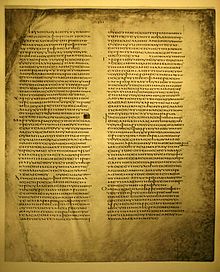
Codex Alexandrinus

From January 1 the readings in the Office to turn to the letter of St Paul to the Romans, so I thought I'd provide a few short notes here to aid reading on it.

The Office, of course, only provides a few extracts from selected chapters; in a monastery the rest is traditionally read either over a meal and/or individually as lectio divina.

The basics

Romans is the sixth book of the New Testament, coming immediately after Acts, and is widely regarded as the most important of St Paul's letters.   It consists of sixteen chapters in total.

The epistle was probably written between 55 and 57 AD, and internal references suggest that it was written while St Paul resided in Corinth.  St Paul was planning to visit Rome, and the letter is in effect a self-recommendation in preparation for that visit by way of doctrine.

Theologically the letter is very dense, and dealing with justification as it does, has spawned many heresies.  Accordingly, it is a good idea to read it with the help of a sound commentary.  Some useful online resources include:


Structure

The following outline is a shortened version of that provided in Fr Kenneth Baker's Inside the Bible:

I Introduction 1:1-18

II There is no salvation apart from Christ 1:18-3:20

III Salvation found only in Christ 3:21-4:25

IV Salvation described and defined 5:1-8:39
Doctrine - Judaism

V Jew and Gentile in God’s plan 9:1-11:36
Practice

VI Moral demands of God’s justice 12:1-15:13

VII Final words and greetings 14:13-16:27