Pages

Matthew 13:44-58


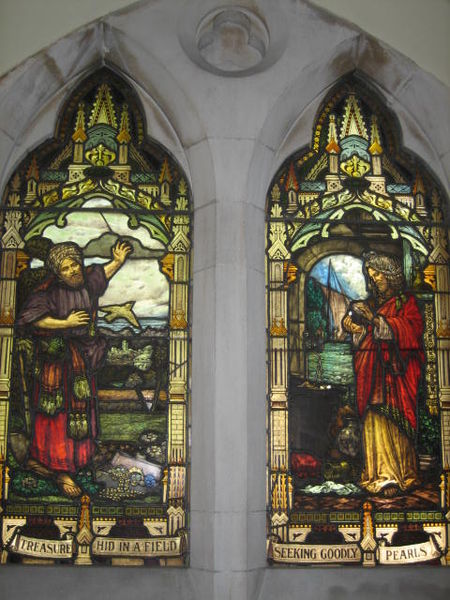
Today's parables from Matthew 13 are the hidden treasure, the pearl and the fishing net:

44 Simile est regnum cælorum thesauro abscondito in agro: quem qui invenit homo, abscondit, et præ gaudio illius vadit, et vendit universa quæ habet, et emit agrum illum. 45 Iterum simile est regnum cælorum homini negotiatori, quærenti bonas margaritas. 46 Inventa autem una pretiosa margarita, abiit, et vendidit omnia quæ habuit, et emit eam. 47 Iterum simile est regnum cælorum sagenæ missæ in mare, et ex omni genere piscium congreganti. 48 Quam, cum impleta esset, educentes, et secus littus sedentes, elegerunt bonis in vasa, malos autem foras miserunt. 49 Sic erit in consummatione sæculi: exibunt angeli, et separabunt malos de medio justorum, 50 et mittent eos in caminum ignis: ibi erit fletus, et stridor dentium. 51 Intellexistis hæc omnia? Dicunt ei: Etiam. 52 Ait illis: Ideo omnis scriba doctus in regno cælorum, similis est homini patrifamilias, qui profert de thesauro suo nova et vetera. 53 Et factum est, cum consummasset Jesus parabolas istas, transiit inde. 54 Et veniens in patriam suam, docebat eos in synagogis eorum, ita ut mirarentur, et dicerent: Unde huic sapientia hæc, et virtutes? 55 Nonne hic est fabri filius? nonne mater ejus dicitur Maria, et fratres ejus, Jacobus, et Joseph, et Simon, et Judas? 56 et sorores ejus, nonne omnes apud nos sunt? unde ergo huic omnia ista? 57 Et scandalizabantur in eo. Jesus autem dixit eis: Non est propheta sine honore, nisi in patria sua, et in domo sua. 58 Et non fecit ibi virtutes multas propter incredulitatem illorum.

And in English:

[44] The kingdom of heaven is like unto a treasure hidden in a field. Which a man having found, hid it, and for joy thereof goeth, and selleth all that he hath, and buyeth that field. [45] Again the kingdom of heaven is like to a merchant seeking good pearls. [46] Who when he had found one pearl of great price, went his way, and sold all that he had, and bought it. [47] Again the kingdom of heaven is like to a net cast into the sea, and gathering together of all kind of fishes. [48] Which, when it was filled, they drew out, and sitting by the shore, they chose out the good into vessels, but the bad they cast forth. [49] So shall it be at the end of the world. The angels shall go out, and shall separate the wicked from among the just. [50] And shall cast them into the furnace of fire: there shall be weeping and gnashing of teeth. [51] Have ye understood all these things? They say to him: Yes. [52] He said unto them: Therefore every scribe instructed in the kingdom of heaven, is like to a man that is a householder, who bringeth forth out of his treasure new things and old. [53] And it came to pass: when Jesus had finished these parables, he passed from thence. [54] And coming into his own country, he taught them in their synagogues, so that they wondered and said: How came this man by this wisdom and miracles? [55] Is not this the carpenter' s son? Is not his mother called Mary, and his brethren James, and Joseph, and Simon, and Jude: [56] And his sisters, are they not all with us? Whence therefore hath he all these things? [57] And they were scandalized in his regard. But Jesus said to them: A prophet is not without honour, save in his own country, and in his own house. [58] And he wrought not many miracles there, because of their unbelief.

Commentary

On these verses, it is hard to go past St John Chrysostom's commentary (Homily 47) on the importance of lectio divina, including on the Old Testament, which takes its cure from verse 51-52:

"Having then uttered all this, and concluded His discourse in a tone to cause fear, and signified that these are the majority of cases (for He dwelt more on them). He says,

Have ye understood all these things? They say unto Him, Yea, Lord.

Then because they understood, He again praises them, saying,

Therefore every Scribe, which is instructed in the Kingdom of Heaven, is like a man that is an householder, which brings forth out of his treasure things new and old. Matthew 13:52

Wherefore elsewhere also He says, I will send you wise men and scribes. Matthew 23:34 Do you see how so far from excluding the Old Testament, He even commends it, and speaks publicly in favor of it, calling it a treasure?

So that as many as are ignorant of the divine Scriptures cannot be householders; such as neither have of themselves, nor receive of others, but neglect their own case, perishing with famine. And not these only, but the heretics too, are excluded from this blessing. For they bring not forth things new and old. For they have not the old things, wherefore neither have they the new; even as they who have not the new, neither have they the old, but are deprived of both. For these are bound up and interwoven one with another.

Let us then hear, as many of us as neglect the reading of the Scriptures, to what harm we are subjecting ourselves, to what poverty. For when are we to apply ourselves to the real practice of virtue, who do not so much as know the very laws according to which our practice should be guided? But while the rich, those who are mad about wealth, are constantly shaking out their garments, that they may not become moth-eaten; do you, seeing forgetfulness worse than any moth wasting your soul, neglect conversing with books? Do you not thrust away from you the pest, adorn your soul, look continually upon the image of virtue, and acquaint yourself with her members and her head? For she too has a head and members more seemly than any graceful and beautiful body...

And her mouth is wisdom and understanding, and the knowledge of spiritual hymns. And her heart, acquaintance with Scripture, and maintenance of sound doctrines, and benevolence, and kindness. And as without this last there is no living, so without that other is never any salvation. Yea, for from that all her excellencies have birth. She has also for feet and hands the manifestations of her good works. She has a soul too, godliness. She has likewise a bosom of gold, and firmer than adamant, even fortitude; and all may be taken captive more easily than that bosom may be riven asunder. And the spirit that is in the brain and heart, is charity."


Should Catholics read Bible books systematically?***


A few weeks ago on Saints Will Arise I suggested a number of options on what to read by way of lectio divina, including looking at the psalms, taking the texts of the Sunday liturgical cycle, reading the Gospels systematically, and reading (the rest of) the Bible.

I've just come across a rather curious post by Father Mark over at Vultus Christi who, in a letter to Oblates of his monastery, argues that a systematic program of Bible reading, or reading the books of Scripture right through is downright uncatholic.

I have to say I find this a rather extreme position.

I'm not sure whether it was meant as a direct response to my post (or queries from his oblates generated by it); probably not.  But thought I would comment on it all the same.  Alas, wordpress won't, for some reason, allow me to post a comment on his blog, so I'm posting it over here instead.

Reading the Bible in order is Protestant?

Fr Mark points rightly to the privileged place Scripture has in the liturgy, and of Scripture as, in a certain sense, a product of the liturgy rather than something that should be viewed as entirely independent of it.  And he points out that Scripture is not a personal book, but something that can only be understood in the midst of the Church.  Thus far I agree.

But he then takes that view a step further than I think can really be sustained, arguing that as a general principle, as Catholics, we should only read the Bible in the context of the readings set at Mass and in the Office:

"Unlike Protestants who may open the Bible at random, or follow a personal reading plan, or use it to prepare a teaching or sermon, Catholic and Orthodox Christians submit to the Church’s use of the Bible in the liturgy...What should one read in lectio divina? In my long personal experience, it is best to focus on the very texts that will be chanted or read, and heard on a given day, in Holy Mass and in the Divine Office..."

He consigns the reading of Scripture in order to rare special occasions:

"There are also moments in life, notably during a retreat or on the occasion of a special anniversary, when one may want to read a particular book of the Bible continuously from start to finish..." 

St Benedict and the tradition on lectio divina

Now I'm all in favour of one option for lectio divina being to base it around the readings in the liturgy.
But to claim this is the only option we should ever adopt seems to me a step too far!

Here is why.

First, St Benedict himself in his Rule sets the precedent in favour of reading books in order, requiring his monks to read least one book a year consecutively (and this would normally have been a book of Scripture) during the season of Lent (RB 48).

Secondly the Fathers (including Benedictine monks like St Bede) and later theologians did not simply stick to the Sunday (or Sanctoral) readings, but produced many commentaries on complete books of Scripture, long viewed as essentially products of lectio divina.  Using them in anthology form obviously has value, but so too, surely, does treating them as complete works in their own right.

Thirdly, many of the Fathers adopt a 'canonical' reading of Scripture, an approach that is regaining popularity today, that interprets sections of Scripture by reference to its placement in the particular book of the Bible.  In the case of the psalms, for example, the particular number of certain psalms is regarded as significant in and of itself.  And canonical interpretation becomes supremely important in the case of obviously carefully crafted orderings of the material such as occur in St John's Gospel in particular, which is structured around 'signs' and 'days'. If we only ever read the snippets of Scripture prescribed for a particular day in the Mass we will surely miss this rich layer of meaning that comes from context.

Fourthly, others have suggested that in fact the monastic tradition is to read the books of the Bible through over a year: in fact, as Dom Christopher Lazowski, in an inspiring post from a few years back on New Liturgical Movement states that:

"There is a monastic adage that states that a monk should pray the Psalter in a week, and should read the Bible in a year...The rest of the Bible is read in a systematic way at the night Office...But the reading of Sacred Scripture is not limited to the liturgy. It is the chief matter of lectio divina, the meditative and prayerful reading, sliding in and out of prayer, that is a vital element of monastic life."

Dom Christopher notes that novices in his own monastery are given a plan for reading the Bible in a year 'which is inspired by the way the different books are read at the Office, with the addition of the books that the Office omits, but without the psalms and the Gospels'.

Finally, there are practical reasons for reading the books straight through as well, not the least of which is that if we only read what occurs in the liturgy we will remain ignorant of large chunks of Scripture (yes even the Novus Ordo lectionary omits whole psalms, chapters and verses of the Bible from its cycle).  Yet the Church has always insisted that all of Scripture is provided for our instruction.

St Matthew continues!

There is certainly a good case for taking the texts of the Mass and/or Office as the basis for our lectio for at least once cycle.  But equally, I think, there is a case for appreciating that God inspired the Sacred authors to write complete books that should be treated as such.

Accordingly, I for one will be plowing on with my systematic reading of St Matthew this quarter!

**Just to note that Fr Mark has written a subsequent post rather modifying his position, and suggesting that reading through the Gospels systematically would be acceptable as a source of lectio.

Possible lectio programs reading the Gospel of St Matthew

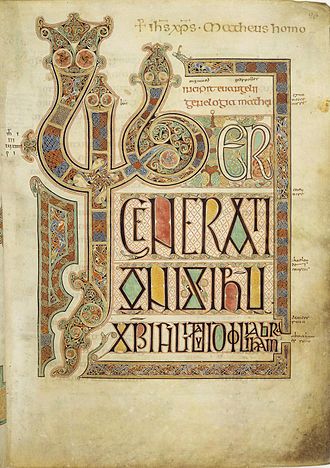
Lindisfarne Gospel

Doing at least some lectio divina each day should surely be a key part of our daily spiritual regime.

But what should we take as our text?  Let me suggest a few options for consideration.

Option 1: Study the psalms

For followers of St Benedict, knowing the psalms is surely the first priority.  St Benedict enjoins the study of the psalms twice in his Rule - once as a use for the gap between Matins and Lauds, and a second time in his discussion of the daily horarium.

Why?

The psalms are of course the backbone of his Office, their repetition each each week so crucial that the lessons are to be dropped if necessary, rather than the psalms be omitted or Lauds started late!  Yet the saint never actually explains why they are so important; rather  he just assumes we know that the psalms are the most quoted book of the Old Testament in the New, and long considered to contain the entire Bible in summary, poetic form.

My blog Psallam Domino is devoted to notes to assist those wishing to use the psalms for lectio divina, or to pray them with greater intensity, particularly in the context of the Benedictine form of the Divine Office.

Option 2: The texts of the Sunday cycle

One obvious option is to use the lectionary and propers used at the Mass.  If you normally attend the 1970 Missal Mass, there is so much material provided in the lectionary that you will have to select what to look at  - one obvious option being the epistles for each day.

In the traditional Mass the obvious option is to look at all the proper texts for the Sunday (and perhaps the texts of the other major feasts and seasons) - that is the Introit, Gradual, Alleluia, Epistle, Gospel, Offertory and Communio - over a week.  The Church has, for centuries, selected out these texts as crucial to our instruction, repeating them year after year so that we can have them practically memorised, so exploring them in more depth for ourselves makes a great deal of sense.

The Sunday Gospels of course can easily take up two or three days in this regime, if one studies them with the aid of patristic sources such as using the excellent Sunday Sermons of the Fathers volumes.  And if the psalm verses or other text in the propers are too sparse or repetitive, it is no great problem to consider the whole psalm or chapter from which the text is taken.

Option 3: Systematic reading of the Gospels

A second option is to spread the reading of the Gospels over a year, taking one for each quarter.  The Gospels are obviously the most important books of the bible for a Catholic to be familiar with, so well worth the effort.  And there are any number of commentaries available to assist this task.  A good starting point is the Catena Aurea of St Thomas, providing an anthology of patristic commentaries for our consideration.

This is the approach I plan to take here, looking at St Matthew's Gospel this quarter on this blog.

Option 4: (Rest of the) Bible in a year

Another option worth considering is systematically reading the rest of the Bible.

If you are feeling ambitious, a while back, a monk posted a suggested two possible reading plans for the Bible in a year over at New Liturgical Movement.  But if you are not a monk with several hours a day to devote to the task, you could devise a plan to spread your reading over two  or three years!

All the same, I will post in a sidebar the books suggested by reading plan 1, which broadly mirrors the Matins readings.

How to do (real) lectio divina


One of Pope Benedict XVI's important contributions to the rehabilitation of Scripture in the lives of Catholics is his instruction on how to do lectio divina

Lectio divina, or holy reading, has been popularised in recent years by assorted monks and others. 

Unfortunately, much of the guidance around amounts to nothing much more than, read the text aloud a few times, seize on whatever part of it gives you a good vibe, and tell everyone about your emotional response to it.

It's the kind of approach that might work well if you are a trained theologian with a good knowledge of the whole of Scripture. But which is extremely dangerous for the typical under-catechized cafeteria Catholic whose acquaintance with Scripture is at best superficial.  Contrast that with the Pope's instructions on how to do real lectio divina, which reflect the real monastic tradition, not the pop version often propagated today under its name.

The stages of lectio divina

Pope Benedict XVI suggests, in his Post-Synodal Exhortation Verbum Domini, that there are five stages to the process:

1. Lectio (a terms that literally means reading, but in late antiquity and medieval usage also encompassed translating, thinking about and studying the text): The Pope suggests that the fundamental question to be answered at this stage is, 'what does the text mean'?

2. Meditatio (meditation): 'what does the biblical text say to us'?

3. Oratio (prayer): 'what do we say to the Lord in response to his word'?

4. Contemplatio (contemplation): 'what conversion of mind, heart and life is the Lord asking of us'?

5. Actio (action; sometimes the term 'work' is used for this stage in medieval schemas for lectio): Putting it into practice.

Using all of the tools at our disposal to get at meaning

It is at the 'lectio' stage that the Pope proposes the integration of the tools offered by exegesis and theology into the process.

He makes the point that Scriptural interpretation is not just a purely individual matter: we must read it in the light of the faith, and in accordance with the principles the Church as set out.
In particular he points to the importance of:  
  • the way the New Testament definitively interprets the Old;
  • the witness of tradition: we must read "in communion with the Church, that is, with all the great witnesses to this word, beginning with the earliest Fathers up to the saints of our own day, up to the present-day magisterium";
  • drawing on the tools of exegesis;
  • with attention to both the literal and spiritual senses of the text (noting that the spiritual is subdivided into three senses which deal with the contents of the faith, with the moral life and with our eschatological aspirations).
The lectio stage, in other words, is not just a matter of reading the text through a few times, but requires serious study.

Meditation through to action

And this intellectual orientation carries through into the other stages of the process. At the meditation stage, for example, he suggests that "we must open ourselves to what God wants to say to us, ‘overcoming our deafness to those words that do not fit our own opinions or prejudices’. The theological implications of the text, in other words, should inform and be the subject of our meditations, prayers and consideration for action.

 It is not, of course, all a matter of intellect. The Pope stresses that lectio divina must be a dialogue with God, involving prayer, as petition, intercession, thanksgiving and praise, so that "the word transforms us".

Dialogue though, involves listening, and listening not just to what we feel personally here and now, but also to what God has said to us through his Church down the ages. Sound advice indeed.

**Reposted from Australia Incognita and Psallam Domino

Recommitting to Lectio divina - start today!

As it is once again the beginning of a new year, I thought this might be a good time to suggest a renewed focus on lectio divina.

You could even add doing fifteen to thirty minutes lectio (depending on how much time you can put aside for this purpose) one of your new year's resolutions.

In praise of lectio divina

Lectio Divina is one of the three key elements of Benedictine life, along with the liturgy and work.

St Benedict's Rule, you will recall, specifies that the monk devote two or three hours (depending on the season) each day to lectio divina and/or learning/meditating on the psalms.

And of course the monk also encountered sacred reading in the Office, at meals, and in the works read at the evening conferences.

Reflecting this, the traditional view was that monks should say all of the psalms each week, and read the entire Bible each year.

For most laypeople that is probably far too ambitious a reading program -  it means reading one of the Gospels each quarter, saying around 22 psalms a day, and reading around two to three other chapters of the Bible each day.  Most people simply won't have time to do that much.

Nonetheless, at least some time devoted to the meditative reading of Scripture each day should be the part of the life of every Christian, and particularly of every Benedictine Oblate, and setting aside fifteen minutes to half an hour each day is enough to make a difference to your spiritual life.

What to read?

There are several options you can consider for your lectio, including:
  • work on really learning the psalms.  For the medieval monk, the Book of Psalms was regarded as a summary of the whole of Scripture, and thus the essential foundation.  My Psallam Domino blog provides notes on many of the psalms, generally interpreted in the context of the Benedictine Office, to aid you in this;
  • use the readings and Mass propers from Sunday Mass.  If you are using the EF calendar, the Sunday cycle provides a rich source of texts that help interpret each other, so you could devote a day each to the Sunday Gospel and Epistle, then for the rest of the week work through the Introit, Gradual, Alleluia or Tract, Offertory and Communio.  Dom Gueranger's Liturgical Year provides useful supporting notes for this purpose; supplement it by listening to the Propers on the CC Watershed website and reading Dom Saulner's wonderful notes on the chants;
  • read one of the Gospels each quarter with the aid of a good commentary.  I have previously provided some notes to aid you on this;
  • use the Matins readings provided on this blog (and for the summer months when there are none in the Benedictine Office, use the Roman ones, which can be found on the Divinum Officium website).

The problem with all the options above, though, good though they each are, is that they won't expose you to the entire Bible, and I think that is problematic: all of Scripture is provided for our instruction, not just some of it.

Accordingly, I think that at least every few years we should set about reading the entire Bible, maybe spread over two or three years.  And to do this, one useful reference point is the Matins lectionary as it stood back in the eighth century.

Lectio continua and the Matins lectionary

The Matins readings, at least in their modern form do not, of course, cover the entire Bible.

The Gospels appear only in the form of the sections used at Mass on Sundays and major feasts.

Some books of the Bible are omitted entirely.

Only tasters are provided for most of the books that are read at Matins.

And for some seasons, such as Lent, Patristic readings entirely displace the Scriptural sequence.

Originally, though, the Matins lectionary was based on a continuous reading of the books of the Bible, starting with the Heptateuch (Genesis to   ) in the lead up to Easter.

The Matins lectionary as it has come down to us though, was originally based on a continuous reading of all of the books of the Old and new Testaments, excluding the Gospels, and so it is worth, I think looking at the outline it provides for the liturgical year, and shaping our own reading around that.


Why do lectio: St John Chrysostom's take on the subject


Homily on Matthew 1:

"It were indeed meet for us not at all to require the aid of the written Word, but to exhibit a life so pure, that the grace of the Spirit should be instead of books to our souls, and that as these are inscribed with ink, even so should our hearts be with the Spirit. But, since we have utterly put away from us this grace, come, let us at any rate embrace the second best course.

For that the former was better, God has made manifest, both by His words, and by His doings. Since unto Noah, and unto Abraham, and unto his offspring, and unto Job, and unto Moses too, He discoursed not by writings, but Himself by Himself, finding their mind pure. But after the whole people of the Hebrews had fallen into the very pit of wickedness, then and thereafter was a written word, and tables, and the admonition which is given by these.

And this one may perceive was the case, not of the saints in the Old Testament only, but also of those in the New. For neither to the apostles did God give anything in writing, but instead of written words He promised that He would give them the grace of the Spirit: for He, says our Lord, shall bring all things to your remembrance. John 14:26 And that you may learn that this was far better, hear what He says by the Prophet: I will make a new covenant with you, putting my laws into their mind, and in their heart I will write them, and, they shall be all taught of God. And Paul too, pointing out the same superiority, said, that they had received a law not in tables of stone, but in fleshy tables of the heart.

But since in process of time they made shipwreck, some with regard to doctrines, others as to life and manners, there was again need that they should be put in remembrance by the written word.

Reflect then how great an evil it is for us, who ought to live so purely as not even to need written words, but to yield up our hearts, as books, to the Spirit; now that we have lost that honor, and have come to have need of these, to fail again in duly employing even this second remedy. For if it be a blame to stand in need of written words, and not to have brought down on ourselves the grace of the Spirit; consider how heavy the charge of not choosing to profit even after this assistance, but rather treating what is written with neglect, as if it were cast forth without purpose, and at random, and so bringing down upon ourselves our punishment with increase.

But that no such effect may ensue, let us give strict heed unto the things that are written; and let us learn how the Old Law was given on the one hand, how on the other the New Covenant....

...it is now proposed for us to speak thereof, let us give careful heed to Matthew, discoursing plainly concerning this: for what he says is not his own, but all Christ's, who has made the laws of this city. Let us give heed, I say, that we may be capable of enrolment therein, and of shining forth among those that have already become citizens thereof, and are awaiting those incorruptible crowns. To many, however, this discourse seems to be easy, while the prophetic writings are difficult. But this again is the view of men who know not the depth of the thoughts laid up therein. Wherefore I entreat you to follow us with much diligence, so as to enter into the very ocean of the things written, with Christ for our guide at this our entering in....

Why, he that is grown old, and has travelled over much country, reports to us with all exactness the number of stadia, and the situations of cities, their plans, and their harbors and markets; but we ourselves know not even how far we are from the city that is in Heaven. For surely we should have endeavored to shorten the space, had we known the distance. That city being not only as far from us as Heaven is from the earth, but even much farther, if we be negligent; like as, on the other hand, if we do our best, even in one instant we shall come to the gates thereof. For not by local space, but by moral disposition, are these distances defined.

...Yea, for we are on the point of entering into a city (if God permit) of gold, and more precious than any gold.

Let us then mark her foundations, her gates consisting of sapphires and pearls; for indeed we have in Matthew an excellent guide. For through his gate we shall now enter in, and much diligence is required on our part. For should He see any one not attentive, He casts him out of the city.

Yes, for the city is most kingly and glorious; not as the cities with us, divided into a market-place, and the royal courts; for there all is the court of the King. Let us open therefore the gates of our mind, let us open our ears, and with great trembling, when on the point of setting foot on the threshold, let us worship the King that is therein. For indeed the first approach has power straightway to confound the beholder.

For the present we find the gates closed; but when we see them thrown open (for this is the solution of the difficulties), then we shall perceive the greatness of the splendor within. For there also, leading you with the eyes of the Spirit, is one who offers to show you all, even this Publican; where the King sits, and who of His host stand by Him; where are the angels, where the archangels; and what place is set apart for the new citizens in this city, and what kind of way it is that leads there, and what manner of portion they have received, who first were citizens therein, and those next after them, and such as followed these. And how many are the orders of these tribes, how many those of the senate, how many the distinctions of dignity.

Let us not therefore with noise or tumult enter in, but with a mystical silence.

For if in a theatre, when a great silence has been made, then the letters of the king are read, much more in this city must all be composed, and stand with soul and ear erect. For it is not the letters of any earthly master, but of the Lord of angels, which are on the point of being read.

If we would order ourselves on this wise, the grace itself of the Spirit will lead us in great perfection, and we shall arrive at the very royal throne, and attain to all the good things, by the grace and love towards man of our Lord Jesus Christ, to whom be glory and might, together with the Father and the Holy Ghost, now and always, even for ever and ever. Amen.

Lectio Divina on St John's Gospel**

Today is the feast of St Jerome, a saint most famous as a translator of the Bible into the vernacular of the time, viz Latin.

In these difficult times, it seems more important than ever that Catholics devote themselves to reading Scripture, both in order to feed their own souls, and so as to be able to assess for themselves the various claims of what Scripture does and does not say.

And of course St Benedict's Rule prescribes a lot of hours of lectio divina, or meditative reading, generally of Scripture.

Accordingly, I thought it might be an appropriate moment to encourage readers to commit to reading St John's Gospel this quarter.

How much can we do - a Bible Reading Plan?

Laypeople will of course, not generally be able to devote the two or three hours that St Benedict prescribes for the task of lectio divina each day.  Still, we can try and do at least a little each day.

An excellent article over at New Liturgical Movement, with associated Bible Reading Plan, from Dom Christopher Lazowski, OSB, a few years ago, suggests that the traditional approach for a monk was to read the Bible in a year.

The psalms of course are read each week, in the Office.

The books other than the Gospels can be read following the broad seasonal ordering set by the Matins readings, and he sets out a couple of schemas there based around this.  Getting through all of the books in a year is a pretty challenging task:  most people living in the world might want to consider a two or three year cycle instead, or perhaps just using the selections of the chapters from the Roman Breviary (which you can find on the Divinum Officium website at Matins); alternatively you could consider doing the Gospels one year, the rest the next.

And the Gospels, of course, can be tackled one for each quarter.  I'm going to focus on that here, looking at St John's Gospel.

Tackling St John's Gospel

In order to read the whole of St John's Gospel (21 chapters) in the course of the quarter (and allowing time out for Sundays, major feasts and Christmastide), you basically need to get through a chapter every two or three days.

Accordingly, I'd suggest trying to read 15-20 verses a day, and focusing in on just a couple of them.

How monks read: doing real lectio

These days lectio divina is often reduced to nothing much more than reading a  few verses, and seeking to come up with one's own entirely subjective response to it.

This is, in my view, an entirely modernist approach that de facto promotes a 'sola scriptura' mentality entirely at odds with the Church's traditional approach to the interpretation of Scripture.

And it is also extremely hard to do for more than half an hour or so, which perhaps explains in part why most modern monasteries don't devote anything like as much time to the task as St Benedict specifies in his Rule.

Traditionally, lectio was a much more intellectual and engaging process.

Unfortunately, reading Scripture in the mind of the Church is not an easy task, for their are relatively few good resources around to assist one.

That's not to say that you need a great theological education to read Scripture of course: just that you need to be given a few tools, like access to a good commentary, to help you as you go.

Dom Paul Delatte's famous Commentary on the Rule of St Benedict nicely captures this, I think, with his summation of the stages of lectio divina as read, think, study, meditate, pray, contemplate, work.

Today, a short rundown on each of these stages of the process by way of an introduction.  You can find more detailed notes on this subject from the links in a sidebar on my Psalm Blog.

Active reading

The first stage of lectio, 'reading' meant much more than just quickly and quietly reading a verse or two as we tend to think of reading.

Rather, it meant reading it out loud, and puzzling out the Latin.  Accordingly, I'm going to provide the text in each post Latin as well as English, together with a link to an audio recording of it.  Even if you don't have any Latin, you can acquire some through the immersion method, and join yourselves to the struggle of those medieval monks, many of whom would have learnt it exactly the same way!

It also meant actually memorizing the text, at least sufficiently well so that you could continue to chew over key sections of it for the rest of the day while doing your manual labour.

Thinking

In order to read Scripture properly, we need to consider both the literal and spiritual senses of the text, as the Catechism (CCC 116-117) explains:

  • "The literal sense is the meaning conveyed by the words of Scripture and discovered by exegesis, following the rules of sound interpretation...
  • The spiritual sense. Thanks to the unity of God's plan, not only the text of Scripture but also the realities and events about which it speaks can be signs. 
The spiritual sense includes:
  • "the allegorical sense. We can acquire a more profound understanding of events by recognizing their significance in Christ; thus the crossing of the Red Sea is a sign or type of Christ's victory and also of Christian Baptism;
  • the moral sense. the events reported in Scripture ought to lead us to act justly. As St. Paul says, they were written "for our instruction";
  • the anagogical sense (Greek: anagoge, "leading"). We can view realities and events in terms of their eternal significance, leading us toward our true homeland: thus the Church on earth is a sign of the heavenly Jerusalem."
Some of this may become obvious to us as we read through the aid of the Holy Ghost.  But we cannot rely solely on inspiration, when perspiration is what God prescribes!

Study

That means reading our text in the light of the rest of Scripture, and the Church's reflections on it.

As the writings of the Fathers attest, a particular verse should never be read in isolation from the rest of the Bible: rather the New is read in the light of the Old, and the Old in the light of the New.  That means being aware of the direct or indirect cross-references to a verse in other parts of Scripture.

Some of the direct cross-references can readily be found in standard Catholic commentaries such as the Navarre Bible, or Haydock's Catholic Bible Commentary.  The medieval system went further than this though, often weaving a web of meaning from verses that used of the same word.  Online tools like the cross-referencing provided by the Blue letter Bible can help you recreate this approach if you choose!

And in terms of Patristic and other commentaries, there are a number of good sources: the Catena Aurea compiled by St Thomas Aquinas and translated by Blessed Cardinal Newman is an excellent starting point for example.

Meditation and prayer

The meditation stage should flow naturally from our study of the text: through it we consider the meaning of the events or words for us in particular and ask for God's help in applying it to our lives.

Contemplation and work

Scripture should become for us a mirror, in which we can hold up our lives and be judged against its measure.  Through contemplation, we can see what we need to change in the future, and then work on implementing the necessary change in our lives.

**Cross-posted from Saints Will Arise Blog