Pages

Introduction to the Epistle to the Hebrews/1


Today, an introduction to a series of posts aimed at supporting lectio divina on the epistle to the Hebrews, drawing mainly on the Commentary of St Thomas Aquinas.

Why read Hebrews?

Fr Hunwicke recently posted a rather sad piece on the failure of Catholics to appreciate the reality and importance of the sacrifice of the Mass.

Personally I think the problem is not just the Mass (central though that is) but a broader issue around our understanding of suffering and sacrifice (viz Arianism is alive and well in our day), not to mention Christology (viz Arianism is alive and well!).  Certainly in my own theological degree the topics of sacrifice and atonement, and their relevance to everyday Christian practice were topics jumped over pretty lightly indeed, and several years later I'm still trying to fill in gaps in my understanding.

In large part I suspect the problem stems from our reluctance to read and engage with the Old Testament thoroughly, and understand the way it foreshadows and teaches us the foundations for the New.  That continuity is of course a key theme in Acts, which I've just finished working through here with the help of St John Chrysostom, but it is most developed in the Epistle to the Hebrews, and so I thought it might make a suitable next subject for lectio.

Authorship and date

The Epistle to the Hebrews is traditionally attributed to St Paul, supported by the testimony of Clement of Rome.  Doubt about his authorship started in the third century, mainly because the style of the Greek is much more polished than his other epistles.

St Thomas Aquinas comments for example that:
... it should be noted that before the Council of Nicaea, some doubted that this was one of Paul’s epistles for two reasons: first, because it does not follow the patters of the other epistles. For there is no salutation and no name of the author. Secondly, it does not have the style of the others; indeed, it is more elegant. Furthermore, no other work of Scripture proceeds in such an orderly manner in the sequence of words and sentences as this one. Hence, they said that it was the work of Luke, the evangelist, or of Barnabas or Pope Clement. For he wrote to the Athenians according to this style.
Nevertheless, the old doctors, especially Dionysius and certain others, accept the words of this epistle as being Paul’s testimony. Jerome, too, acknowledges it as Paul’s epistle.
St Thomas provides some arguments to counter the virtual consensus of modern scholars against Pauline authorship:
To the first argument, therefore, one may respond that there are three reasons why Paul did not write his name: first, because he was not the apostle of the Jews but of the Gentiles: ‘He who wrought in Peter to the apostleship of the circumcision, wrought in me also among the Gentiles’ (Gal. 2:8); consequently, he made no mention of his apostleship at the beginning of this epistle, because he was unwilling to speak of it except to the Gentiles. Secondly, because his name was odious to the Jews, since he taught that the observance of the Law were no longer to be kept, as is clear from Acts (15:2). Consequently, he concealed his name, lest the salutary doctrine of this epistle go for naught. Thirdly, because he was a Jew: ‘They are Hebrews: so am I’ (2 Cor. 11:22). And fellow countrymen find it hard to endure greatness in their own: ‘A prophet is not without honor, save in his own country and in his own house’ (Mt. 13:57).
To the second argument the answer might be given that the style is more elegant, because even though he knew many languages: ‘I speak with all your tongues’ (1 Cor. 14:18), he knew the Hebrew language better than the others, for it was his native tongue, the one in which he wrote this epistle. As a result, he could write more ornately in his own idiom than in some other language; hence, he says: ‘For though I be rude in speech, yet not in knowledge’ (2 Cor. 11:6). But Luke, who was a skillful writer, translated this ornate Hebrew into Greek.
Regardless of authorship, most accept that it was written early, possibly around 63-64 AD.

Length and structure

Hebrews has thirteen chapters, and there are various ways of dividing them.

Modern scholars tend to divide it into five parts: Christ's pre-existence; his superiority over the angels; his superiority over Moses; Christ's priesthood; his sacrifice compared to the sacrifices of the Old Law.

Commentaries

While Hebrews is a text that really does benefit from the insights of modern scholarship, particularly from the Dead Sea Scrolls and related literature (and I'll try and provide a few comments and links on this here and there), there are two key commentaries from the Fathers and Doctors that are available online and well worth reading.

The first is by St John Chrysostom.  His commentary on Hebrews focuses above all on the idea of redemptive suffering.  He sees the Epistle as a document of encouragement for Jewish converts:
...that they might not think themselves forsaken..that they should bear nobly whatever befalls them; the other, that they should look assuredly for their recompense. For truly He will not overlook those with Abel and the line of unrewarded righteous following him.
Chrysostom also focuses on St Paul's use of the Old Testament as proof of the Resurrection:
But he speaks much of both the New and the Old Covenant; for this was useful to him for the proof of the Resurrection. Lest they should disbelieve that [Christ] rose on account of the things which He suffered, he confirms it from the Prophets, and shows that not the Jewish, but ours are the sacred [institutions]
St Thomas Aquinas argues that the focus of the Epistle is "Christ’s grandeur to show the superiority of the New Testament over the Old", "what unites the members to the head, namely, faith".  His Prologue to his commentary on Hebrews provides an exposition of Christ's transcendence by way of introduction to the text, and I'll post some of that tomorrow.

My approach

I plan to use extracts from St Thomas' commentary by way of a change of pace (though we won't entirely abandon Chrysostom, since St Thomas frequently quotes him) in terms of material to support close reading, study and meditation on the text.

I will be using the translation of the text by Fabian R. Larcher, O.P (provided over at the Dominican Priory website linked to above).

Both St Thomas' and St John's commentaries are quite long: Chrysostom's for example, averages about three homilies per chapter (compared to around two for each chapter of Acts); and  the Dominican Priory website divides St Thomas' text into 52 separate sections.

For this reason, I'm going to be moving fairly slowly through the text.  I'll also plan on inserting in any key Old Testament texts (particularly those likely to be less familiar).

All the same, I do plan on editing rather heavily, and cutting out a lot of the Commentary, so I would encourage you to go and read the full commentary (and that of St John) if you have time.

I&II Kings (aka I&II Samuel)

Икона пророка Самуила из собрания ДОХМ.jpg
The prophet Samuel
Russian c17th

From the Second Sunday after Pentecost, the Matins readings (on Sundays in the Benedictine Office) work through I&II Kings (or I&II Samuel depending on which Bible you are using), so herewith a short introduction to it.

**I should note as an aside that, as foreshadowed a few weeks ago, I plan to start posting on Hebrews from next week.

Importance of Kings

Kings doesn't get much of a run in the traditional Mass lectionary - its sole entry as far as I can find is on Monday after the fourth Sunday of Lent (2 Kings 3:16-28).

But it is extremely important in terms of the history of Israel, covering the period roughly about 1070 - 970 BC, and includes some key 'types' of Jesus, including in the nativity story of Samuel, as well, of course, as in the life and promises made to King David.

About 1&2 Kings

Kings comes immediately after Ruth in the Bible.  I  Kings has 31 chapters; II Kings has 24.

Jewish tradition held it to have been written by Samuel, whose story it sets out, with additions by the prophets Gad and Nathan.  Certainly conservative scholars have generally dated it to the reign of Kings David and Solomon circa 1000-930BC.  But of course modern(ist) scholars dispute this, suggesting it was probably written around  630-540 BC.

The storyline starts with the conception of Samuel by Hannah after her pleading with God at the shrine of Silo.  Samuel becomes a judge and prophet, but inaugurates the monarchy with his anointing of Saul and then David.  Much of the first book then deals with the conflicts between the two.  Book II mainly deals with reign of David, up to death of Absalom.

Some of its key themes include God as the Lord of history, working his will through fallible and sinful human beings; the model of friendship provided by Jonathan and David; the effects of sin; and the dependence of a nation’s happiness on its leaders’ personal holiness

Some of its most important moments include:
  • Hannah’s song of praise, which is the key source text for the Magnificat (2 Kings 2:1-10), said in the Benedictine Office on Wednesday's at Lauds (ferial canticle);
  • Samuel's vocation story (1 Samuel 3);
  • the loss of the Ark of the covenant to the Philistines, and subsequent punishment of the priests of Silo (I Kings  4-6);
  • the promise to David that his descendants will rule forever (2 Kings 7);
  • David's adultery with Bathsheba, and subsequent repentance (2 Kings 11).
Structure

I Kings starts off with the story of the priest Eli and Samuel, moves to the establishment of the monarchy, and from chapter 13 onwards deals with the conflict between David and Saul.  Book II is primarily concerned with David, and conflict within his house (chapters 9-20).

I&II Kings in the Matins lectionary

In the Benedictine Office (unlike the Roman), I&II Kings is read over the period when there are no weekday readings, and so the readings set are for Sundays only:

Second Sunday after Pentecost: 1 Kings (I Samuel) 1:1-11
Third Sunday after Pentecost: 1 Kings (I Samuel) 9:18-10:1
Fourth Sunday after Pentecost: 1 Kings (I Samuel) 17:1-16
Fifth Sunday after Pentecost: 2 Kings (II Samuel) 1:1-15
Sixth Sunday after Pentecost: 2 Kings (II Samuel) 12:1-16.

Scriptural readings at Matins in the Benedictine Office

For those wanting to plan out their lectio divina, here is a listing of the Scriptural readings covered at Matins in the Benedictine Office.

It only covers non-Gospel Scriptural readings - for full lists of the readings see the more detailed posts for the various liturgical seasons.  In the Benedictine Office there are no weekday readings during summer.

The main point to note is that the readings do not cover the entire Bible. The Matins cycle does of course have to be considered in conjunction with the Epistles read at Mass, and the texts set for feasts (including of the saints).  All the same:
  • some books are not read at all, or get only one or two readings (generally for feasts) - the books of the Pentateuch other than Genesis, Chronicles (Parahelion), Acts, and Revelations in particular get short shrift;
  • even those that are included can be omitted depending on the number of weeks after Epiphany and Pentecost;
  • the readings typically select out a few verses from the opening chapters of many books, they don't cover the full chapter or book; and
  • some receive a quite disproportionate amount of time on the face of it (Maccabees for example, compared to the Wisdom books).
In a monastery of course, the Matins readings would be supplemented by table readings during meals, readings after Vespers and the monk's own lectio divina.

Advent: Isaiah

Advent 1
Sunday: Isaiah 1:1-11
Monday: Isaiah 1: 16-28)
Tuesday: Isaiah 2:1-9
Wednesday: Isaiah 3:1-11
Thursday: Isaiah 4: 1-7
Friday: Isaiah 6:1-10
Saturday: Isaiah 7:1-15

Advent 2

Sunday: Isaiah 11:1-13
Monday: Isaiah 13: 1-11
Tuesday: Isaiah 14:1-15
Wednesday: Isaiah 16:1-8
Thursday: Isaiah 19: 1-13
Friday: Isaiah 24:1-16a
Saturday: Isaiah 25:1-4a, 4b-7, 8-12

Advent 3

Sunday: Isaiah 26:1-14
Monday: Isaiah 28:1-18a
Tuesday: Isaiah 30 18-28
Wednesday (Ember Day)
Thursday: Isaiah 33:1-17
Friday: Ember Day
Saturday: Ember Day

Advent 4

Sunday: Isaiah 35:1-10; 41: 1-4
Monday: Isaiah 41:8-10, 11-13; 14-16
Tuesday: Isaiah 42:1-13
Wednesday: Isaiah 51:1-8
Thursday: Isaiah 64:1-11
Friday: Isaiah 66:5-16

Christmastide: Romans

Christmas Day: Isaiah 9:1-6; 40:1-8; 52:1-6
Sunday in the Octave of Christmas: Romans 1: 1-19
St Stephen (Dec 26): Acts 6:1-10; 7:54-60a
St John (Dec 27): 1 John 1:1-5a
Holy Innocents (Dec 28): Jeremiah 31:1-23

1 January (Octave of the Nativity): Romans 4 1-17
2 January: Romans 5: 1-12
3 January: Romans 6:1-18
4 January: Romans 7:1-9
5 January: Romans 8:1-11
Feast of the Epiphany (Jan 6): Isaiah 55:1-4; 60:1-6;61: 10-11; 62:1
7 January: Romans 9:1-16
8 January: Romans 12:1-16
9 January: Romans 13:1-10
10 January: Romans 14:1-13
11 January: Romans 15:1-16
12 January: Romans 15:17-27
13 January: Baptism of Our Lord (generally of the date but displaced by the Sunday)

Epiphanytide: Epistles of St Paul

First week after Epiphany

Sunday: 1 Corinthians I: 1-13
Monday: 1 Corinthians 2: 1-13
Tuesday: 1 Corinthians 5: 1-11
Wednesday: 1 Corinthians 6: 1-18
Thursday: 1 Corinthians 7: 1-14
Friday: 1 Corinthians 13: 1-13
Saturday: 1 Corinthians 16: 1-14

Second week after Epiphany

Sunday: 2 Corinthians 1: 1-5, 6-7, 8-11, 12-13
Monday: 2 Corinthians 3: 1-3, 4-8, 9-14
Tuesday: 2 Corinthians 5: 1-4, 6-10, 11-15
Wednesday:2 Corinthians 7: 1-3, 4-7, 8-10
Thursday: 2 Corinthians 10: 1-3, 4-9, 10-12
Friday:2 Corinthians 12: 1-4, 5-9, 9-11
Saturday: 2 Corinthians 13: 1-4, 5-9, 10-13

Third week after Epiphany

Sunday: Galatians 1: 1-5; 6-8, 9-10, 11-14
Monday: Galatians 3
Tuesday: Galatians 5
Wednesday: Ephesians 1
Thursday: Ephesians 4
Friday: Ephesians 5
Saturday: Ephesians 5

Fourth week after Epiphany

Sunday:  Philippians 1
Monday: Philippians 4
Tuesday: Colossians 1
Wednesday: Colossians 3
Thursday: 1 Thessalonians 1
Friday: 1 Thessalonians 4
Saturday: 2 Thessalonians 1

Fifth Week after Epiphany

Sunday:  1 Timothy 1
Monday: 1 Timothy 3
Tuesday: 2 Timothy 1
Wednesday: 2 Timothy 3
Thursday: Titus 1
Friday: Titus 3
Saturday: Philemon

Sixth Week after Epiphany

Sunday:  Hebrews 1
Monday: Hebrews 3
Tuesday: Hebrews 4
Wednesday: Hebrews 6
Thursday: Hebrews 7
Friday: Hebrews 11
Saturday: Hebrews 13

Septuagesimatide: Genesis

Septuagesima Sunday: Genesis 1:1-26
Monday after Septuagesima Sunday: Genesis 1:27-31; 2: 1-10
Tuesday: Genesis 2:1-24
Wednesday: Genesis 3:1-20
Thursday: Genesis 4:1-16
Friday: Genesis 4:17-26; 5:1-5
Saturday: Genesis 5:15-31

Sexagesima Sunday: Genesis 5:32, 6:1-15
Monday after Sexagesima Sunday: Genesis 7: 1-5& 10-14&17
Tuesday: Genesis 8:1-4; 5-9; 10-13
Wednesday: Genesis 8:1 -22; 9:1-6
Thursday: Genesis 9:12-29
Friday: Genesis 10:1-6; 11:1-8
Saturday: Genesis 11:10--30

Quinquagesima Sunday: Genesis 12: 1-19
Monday after Quinquagesima Sunday: Genesis 13:1-16
Tuesday: Genesis 14: 8-20

Lent

First Sunday of Lent: 2 Corinthians 6:1-9
Sunday II in Lent:  Genesis 27:1-29
Third Sunday of Lent: Genesis 37:2-25
Fourth Sunday in Lent: Exodus 3:1-15

Passiontide and Holy Week: Jeremiah; Lamentations

First Passion Sunday:  Jeremiah 1: 1-19
Palm Sunday: Jeremiah 2:12-32
Holy Tuesday: Jeremiah 11:1520; 12: 1-11
Holy Wednesday: Jeremiah 17:13-18; 18: 13-23
Maundy Thursday: Lamentations 1: 1-14
Good Friday: Lamentations 2: 8-15; 3: 1-9
Holy Saturday: Lamentations 3:22-30;4:1-6; 5:1-11

Eastertide

Easter Sunday:  Romans 6: 2-13
Low Sunday: Colossians 3: 1-17
Second Sunday after Easter: Acts 1: 1-26
Third Sunday after Easter: Revelation 1:1-19
Fourth Sunday after Easter: St James 1:1-16
Fifth Sunday after Easter: 1 Peter 1: 1-9

Feast of the Ascension: Acts 1: 1-14
Sunday after the Ascension: 1 John 1:1-10; 2: 1-6
Pentecost Sunday: Acts 2: 1-21

Trinity Sunday: Isaiah 6:1-12
Corpus Christi: 1 Corinthians 11:20-32

[NB Readings are of the month from the first Sunday of August]

After Pentecost: 1&2 Samuel; 1&2 Kings

Second Sunday after Pentecost: 1 Kings (I Samuel) 1:1-11
Sacred Heart: Jeremiah 24:5-7; 30: 18-19, 21-24; 31:1-3; 31-33
Third Sunday after Pentecost: 1 Kings (I Samuel) 9:18-10:1
Fourth Sunday after Pentecost: 1 Kings (I Samuel) 17:1-16
Fifth Sunday after Pentecost: 2 Kings (II Samuel) 1:1-15
Sixth Sunday after Pentecost: 2 Kings (II Samuel) 12:1-16
Seventh Sunday after Pentecost: 3 Kings (I Kings) 1:1-15
Eighth Sunday after Pentecost: 3 Kings (I Kings) 9:1-14
Ninth Sunday after Pentecost: 4 Kings (II Kings): 1:1-10)
Tenth Sunday after Pentecost: 4 Kings (II Kings) 9: 29-10:7
Eleventh Sunday after Pentecost: 4 Kings (II Kings) 20:1-11

[NB Number of Sundays in the month depends on the calendar year]

August: Proverbs, Ecclesiasticus, Wisdom, Sirach

First Sunday of August: Proverbs 1: 1-22
Second Sunday of August: Ecclesiastes 1:1-17
Third Sunday of August: Wisdom 1: 1-13
Fourth Sunday of August: Ecclesiasticus (Sirach) 1:1-16
Fifth Sunday of August: Ecclesiasticus 5:1-16

September: Job, Tobit, Judith and Esther

First Sunday in September: Job 1:1-11
Second Sunday in September: Job 9:1-17
Third Sunday in September: Tobit 1:1-15
Fourth Sunday in September: Judith 1:1-12: 2:1-3
Fifth Sunday in September: Esther 1:1-9

October: 1&II Maccabees

First Sunday in October: 1 Maccabees 1:1-16
Second Sunday in October: 1 Maccabees 4:36-51
Third Sunday in October: 1 Maccabees 9:1-20
Fourth Sunday in October: 2 Maccabees 1: 1-22

November: Ezekiel, Daniel and Minor Prophets

First Sunday in November: Ezekiel 1: 1-12
[weekday readings: Ezekiel 2, 3, 7, 14, 15, 19]
Second Sunday in November: always omitted
Third Sunday in November: Daniel 1:1-15
[weekdays: Daniel 2, 3, 4,5,6,9]
Fourth Sunday in November: Hosea 1:1-11
[Weekdays: Hosea 4; Joel 1, 3; Amos, Abdias (Obadiah), Jonah]
Fifth Sunday in November: Micah 1:1-9
[Weekdays: Nahum 1; Habacuc 1; Sophonias (Zeppaniah) 1; Aggaeus (Haggai) 1; Zachariah 1; Malachias 1]

St Paul's Letter to the Romans


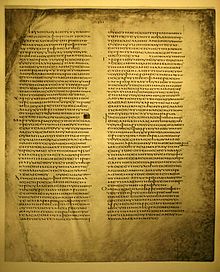
Codex Alexandrinus

From January 1 the readings in the Office to turn to the letter of St Paul to the Romans, so I thought I'd provide a few short notes here to aid reading on it.

The Office, of course, only provides a few extracts from selected chapters; in a monastery the rest is traditionally read either over a meal and/or individually as lectio divina.

The basics

Romans is the sixth book of the New Testament, coming immediately after Acts, and is widely regarded as the most important of St Paul's letters.   It consists of sixteen chapters in total.

The epistle was probably written between 55 and 57 AD, and internal references suggest that it was written while St Paul resided in Corinth.  St Paul was planning to visit Rome, and the letter is in effect a self-recommendation in preparation for that visit by way of doctrine.

Theologically the letter is very dense, and dealing with justification as it does, has spawned many heresies.  Accordingly, it is a good idea to read it with the help of a sound commentary.  Some useful online resources include:


Structure

The following outline is a shortened version of that provided in Fr Kenneth Baker's Inside the Bible:

I Introduction 1:1-18

II There is no salvation apart from Christ 1:18-3:20

III Salvation found only in Christ 3:21-4:25

IV Salvation described and defined 5:1-8:39
Doctrine - Judaism

V Jew and Gentile in God’s plan 9:1-11:36
Practice

VI Moral demands of God’s justice 12:1-15:13

VII Final words and greetings 14:13-16:27

Lectio divina on Acts

St John Chrysostom introduces his commentary on Acts with some comments on its importance and authorship:

To many persons this Book is so little known, both it and its author, that they are not even aware that there is such a book in existence. For this reason especially I have taken this narrative for my subject, that I may draw to it such as do not know it, and not let such a treasure as this remain hidden out of sight. For indeed it may profit us no less than even the Gospels; so replete is it with Christian wisdom and sound doctrine, especially in what is said concerning the Holy Ghost. Then let us not hastily pass by it, but examine it closely. Thus, the predictions which in the Gospels Christ utters, here we may see these actually come to pass; and note in the very facts the bright evidence of Truth which shines in them, and the mighty change which is taking place in the disciples now that the Spirit has come upon them. For example, they heard Christ say, Whoso believes in Me, the works that I do shall he do also, and greater works than these shall he do John 14:12: and again, when He foretold to the disciples, that they should be brought before rulers and kings, and in their synagogues they should scourge them, and that they should suffer grievous things, and overcome all Matthew 10:18: and that the Gospel should be preached in all the world Matthew 24:14: now all this, how it came to pass exactly as it was said, may be seen in this Book, and more besides, which He told them while yet with them. Here again you will see the Apostles themselves, speeding their way as on wings over land and sea; and those same men, once so timorous and void of understanding, on the sudden become quite other than they were; men despising wealth, and raised above glory and passion and concupiscence, and in short all such affections: moreover, what unanimity there is among them now; nowhere any envying as there was before, nor any of the old hankering after the preeminence, but all virtue brought in them to its last finish, and shining through all, with surpassing lustre, that charity, concerning which the Lord had given so many charges saying, In this shall all men know that you are My disciples, if you love one another. John 13:35 And then, besides, there are doctrines to be found here, which we could not have known so surely as we now do, if this Book had not existed, but the very crowning point of our salvation would be hidden, alike for practice of life and for doctrine.

"The greater part, however, of this work is occupied with the acts of Paul, who laboured more abundantly than they all. 

And the reason is, that the author of this Book, that is, the blessed Luke, was his companion: a man, whose high qualities, sufficiently visible in many other instances, are especially shown in his firm adherence to his Teacher, whom he constantly followed. 

Thus at a time when all had forsaken him, one gone into Galatia, another into Dalmatia, hear what he says of this disciple: Only Luke is with me.  And giving the Corinthians a charge concerning him, he says, Whose praise is in the Gospel throughout all the Churches.  Again, when he says, He was seen of Cephas, then of the twelve, and, according to the Gospel which you received, he means the Gospel of this Luke. So that there can be no mistake in attributing this work to him: and when I say, to him, I mean, to Christ. 

And why then did he not relate everything, seeing he was with Paul to the end? We may answer, that what is here written, was sufficient for those who would attend, and that the sacred writers ever addressed themselves to the matter of immediate importance, whatever it might be at the time: it was no object with them to be writers of books: in fact, there are many things which they have delivered by unwritten tradition. 

Now while all that is contained in this Book is worthy of admiration, so is especially the way the Apostles have of coming down to the wants of their hearers: a condescension suggested by the Spirit who has so ordered it, that the subject on which they chiefly dwell is that which pertains to Christ as man. For so it is, that while they discourse so much about Christ, they have spoken but little concerning His Godhead; it was mostly of the Manhood that they discoursed, and of the Passion, and the Resurrection, and the Ascension. For the thing required in the first instance was this, that it should be believed that He was risen, and ascended into heaven. 

As then the point on which Christ himself most insisted was, to have it known that He had come from the Father, so is it this writer's principal object to declare, that Christ was risen from the dead, and was received up into Heaven, and that He went to God, and came from God. For, if the fact of His coming from God were not first believed, much more, with the Resurrection and Ascension added thereto, would the Jews have found the entire doctrine incredible. Wherefore gently and by degrees he leads them on to higher truths. Nay, at Athens Paul even calls Him man simply, without saying more. For if, when Christ Himself spoke of His equality with the Father, they often attempted to stone Him, and called Him a blasphemer for this reason, it was little to be expected that they would receive this doctrine from the fishermen, and that too, with the Cross coming before it.

But why speak of the Jews, seeing that even the disciples often upon hearing the more sublime doctrines were troubled and offended? Therefore also He told them, I have many things to say unto you, but you cannot bear them now.  If those could not, who had been so long time with Him, and had been admitted to so many secrets, and had seen so many wonders, how was it to be expected that men, but newly dragged away from altars, and idols, and sacrifices, and cats, and crocodiles (for such did the Gentiles worship), and from the rest of their evil ways, should all at once receive the more sublime matters of doctrine? And how in particular should Jews, hearing as they did every day of their lives, and having it ever sounded in their ears, The Lord your God is one Lord, and beside Him is none other who also had seen Him hanging nailed on the Cross, nay, had themselves crucified and buried Him, and not seen Him even risen: when they were told that this same person was God and equal with the Father, how should they, of all men, be otherwise than shocked and revolted? 

Therefore it is that gently and little by little they carry them on, with much consideration and forbearance letting themselves down to their low attainments, themselves the while enjoying in more plentiful measure the grace of the Spirit, and doing greater works in Christ's name than Christ Himself did, that they may at once raise them up from their grovelling apprehensions, and confirm the saying, that Christ was raised from the dead. For this, in fact, is just what this Book is: a Demonstration of the Resurrection: this being once believed, the rest would come in due course. The subject then and entire scope of this Book, in the main, is just what I have said. And now let us hear the Preface itself.

Reading Plan for St Luke's Gospel

This coming quarter I plan to provide lectio divina prompts for St Luke's Gospel.

How much time?

In his Rule, St Benedict points us to several key means of sanctification, including:
  • acceptance of the call to conversion, and perseverance in the 'narrow way of salvation' (especially the Prologue to the Rule);
  • cultivation of obedience and humility (especially chapters 5-7 of the Rule);
  • practice of the tools of good works (especially chapter 4);
  • the liturgy of the Divine Office, the Opus Dei (especially chapters 8-20); 
  • work (esp chapter 48); and 
  • spiritual reading (Chapter 48).

Our reading, then, should be part of a balanced program, reflecting our state in life: Carthusian monks, who have few other demands on their time might be able to do several hours a day of it; but those living in the world with families and a job might only be able to manage a few minutes or so!

Even so, a few minutes can be of great benefit to us, so it is worth trying to carve out the time each day.

The point of lectio divina, it must be remembered, is not just to quickly read through the text as if it was a work of fiction which we want to read quickly in order to find out what happens.   Rather, the idea is ponder it so that it can act as a mirror to our souls, and a guide to our living.  Accordingly, depending on how much time you can allocate to lectio each day, you might want to read through the text here each day, but then focus in on one or two particular verses.

I'd also strongly encourage you to at least read through and/or listen to the Latin - even if you haven't studied Latin, you will gradually be able to start picking out the words, absorb it, and at the very least be able to recognise it when you hear it at Mass.  And reading and hearing the Greek can also be of benefit given that was the language it was written in.

This might also be a good point to take a (another) look at my notes on how to do lectio divina.  The key point is that these posts are intended as a starting point for your own study and meditation, not the end point!

St Luke

St Luke's Gospel provides us with some rich material from Our Lady on the events surrounding the nativity of Christ, so I plan to linger on those early chapters a little.  In particular, given that we say the Benedictus and Magnificat canticles taken from St Luke daily in the Office, I thought I'd send a couple of days on those, to provide you with some possible starting points for probing deeper into the meaning of these texts to which the Church has attached so much importance.

As usual, I'll take a break for Sunday and the major feasts, and provide the Gospel of the day (from the EF/traditional Benedictine calendar) and third nocturn Matins readings on them instead.  I should note though that on July 2, the feast of the Visitation, the Gospel is actually from St Luke 1, so I've arranged it so that the Gospel text appears in sequence.

With that in mind, I anticipate reaching chapter 8 of St Luke's Gospel by the end of July, and chapter 18 by the end of August, finishing St Luke by the end of September.

In terms of commentary, I'll provide extracts mainly from the classic commentary of Cornelius de Lapide this time around, occasionally supplemented by other sources such as the Catena Aurea compiled by St Thomas Aquinas.

Other books of the Bible

For those interested in reading more of the Bible than just the Gospels, I've updated (and will keep updated!) my summary (which you can find in a sidebar) of the Bible in a Year Reading Plan 1 put together by Dom Christopher Lazowski, OSB.

The plan loosely mirrors the order of readings at Matins (noting of course that the Benedictine Office doesn't have variable Scriptural readings during the week over the Northern Hemisphere summer).

The Gospel of St Mark

I'm planning to resume providing prompts for lectio divina this week, with a look at the Gospel of St Mark.

St Mark is actually my favourite of the Gospels, since it seems to provide the perspective of St Peter, and gives a strong picture of what it was like to be a disciple.  It also has the virtue of being the shortest of the Gospels, making it easier to memorize!

Commentary

There are, unfortunately few major patristic commentaries on St Mark available online, and so I thought this might be a good opportunity to dip into the highly thought of seventeenth century commentary of Cornelius de Lapide as the primary aid for reading this Gospel.

Useful resources

For further reference, I've listed below some useful resources on St Mark available online.

Translations

New Advent (Septuagint, Vulgate, Knox translation)
Douay-Rheims

Introductions and commentaries

de Lapide
Haydock
Catena Aurea

Divine Lamp

Lectio divina: meditation to work


So far in this series on Lectio Divina I've looked at reading, thinking about and studying the text.  I don't want to say a great deal about the final stages of the process, meditation, prayer, contemplation and work, but for the sake of completeness, a few comments nonetheless.

Our Lady as a model of meditation

The first thing to say is that Our Lady is generally regarded as the ultimate model for lectio divina. Meditation in the Benedictine tradition follows that idea of Our Lady treasuring all those things in her heart, turning them over and over, and reflecting on their meaning.

In the post on study I suggested the kinds of things one can look for flowing out of the words of the text, but in reality there are many different methods of meditation, and I think you just have to find one that works for you. I prefer the idea of keeping going back to the text, and seeing what you can draw out of it. But the Ignatian idea of putting yourself into the Biblical scene and engaging each of the senses, for example, can be equally helpful depending on your personality!

Why we meditate

The key point to bear in mind I think is the purpose of all this.

First we have to be actively listening to what God is trying to say to us - open to having our view of ourselves and the world changed by imitating Christ and accepting the implications of the truths Scripture and Traditional reveal.

Secondly, seeing how we fall short of the Gospel ideal, seeing the cracks in our worldview when it is held up to the mirror of the Scripture is a necessary start.

But we also have to genuinely want to change, to constantly recommit ourselves to strive for perfection - and that means looking to Scripture for the reasons why we should embark on this path. Meditating on the joys of heaven, the happiness we can achieve now, the rewards Our Lord promises can be helpful too!

Finally, we need to look at Scripture to find the tools we need to change - through Advent, many of the readings have focused on the need for repentance and confession. There is a lot more there to be found and utilised though, if, for example, we look at how Our Lord taught the disciples, and not just in words!

Meditation really should take up the bulk of the time you set aside for lectio divina - or at least the work you do in that time should set you up to meditate fruitfully on the text as you do other things during the day. Think about leaving the radio (or Ipod) off as you are do housework, drive to work, or go for a walk for example, and taking one of the lines of thought you have identified as you pursue these activities!

Prayer

Closely related to meditation is prayer.  In this schema prayer comes a fair way down the list, but in reality it has to be part of every stage of lectio - as the part of the preparation we make before starting (as with every and any task!), to guide our thought and study, and of course our meditation. St Teresa of Avila described prayer as just like a conversation with a friend, and that is a concept to keep in front of our minds all the time.

At the same time, it will be pretty evident by this point I hope, that the kind of prayer that should emerge from lectio divina in my view is not just some spontaneous charismatic-style thought to 'share', but something considered.  And it can often be helpful to try writing out your prayer, using it to summarise what you have taken out of the reading and linking it to the request for aid.

If you are looking for models on how to do this, go to the Masters! The psalms for example, particularly, those that reflect on the history of Israel. Or St Augustine's reflections on Genesis in the last few books of his Confessions.

Some of my most favourite Lectio style prayers though are those of Dame Gertrude More (a seventeenth century English Benedictine nun) and those of St Anselm. The latter for example says things like:

"St Mary Magdalene,
you came with springing tears
to the spring of mercy, Christ;
from him your burning thirst was abundantly refreshed;
through him your sins were forgiven;
by him your bitter sorrow was consoled.
My dearest lady,
well you know by your own life
how a sinful soul can be reconciled with its creator,
what counsel a soul in misery needs,
what medicine will restore the sick to health....

herefore, since you are now with the chosen
because you are beloved
and are beloved because you are chosen of God...

Ask urgently that I may have
the love that pierces the heart; tears that are humble;
desire for the homeland of heaven;
impatience with this earthly exile;
searing repentance; and a dread of torments in eternity..."

Our poor efforts won't be as worthy of preservation as these of course, but the discipline of writing them down - and being able to go back to them for reference purposes - can be useful at times!

Contemplation

The hope, of course, is that this active form of prayer will move to wordless contemplation infused by God. This is, however, a gift to be freely bestowed on us, not something we can achieve for ourselves unaided.  What we can do, though, is seek through our prayer to find an inner stillness where we push away all the distracting thoughts that pull us down, seeking an inner stillness that can be filled by God.

Work

The last stage of the schema I’m advocating for Lectio Divina is Work, or putting it all into practice.

Today it is popular to focus on acceptance – of ourselves and others. But this runs directly counter to our tradition, which recognizes that humans are imperfect and inclined to sin, and urges us to struggle for perfection.  We should recognize and even worship God present in others – but we also have to recognize and struggle against everything that makes us unworthy temples of the Holy Spirit.

In essence we read Scripture not just because it is interesting or entertaining – not because it ‘validates’ us - but because of its potential to change our lives, fostering our ongoing conversion. So as we do our lectio, we should be listening out for the ways of putting what we have learnt into practice in our lives.

Models of behavioural change

One of the more useful models of behaviour change points to a five stage process – the first is seeing our undesirable behaviour or flawed worldview for what it is. Most of the time we look at the world through the lens of a set of beliefs about what we are seeing and an image of ourselves. But it is not for nothing, that the psalmist urges us to pray that our secret sins might be forgiven: seeing the mote in our eye can be the hardest step in changing.

The key to making major or minor changes in our lives is to realize that the costs of not changing are greater than those of staying as we are. And in this spiritual life this has to be a continual process, since we know we must seek perfection, even if we can never achieve absolute perfection in this life.

The third important factor in making changes is finding the tools to help us. Scripture provides us with both models and injunctions about how we should behave. You can compile up sets yourself as you do your lectio, or look at the distillations in both Scripture and the tradition - the Wisdom literature in the Old Testament, for example, can be particularly useful here. So to distillations of key precepts from Scripture such as the fourth chapter of St Benedict’s Rule, his tools of good works, which start from the commandments, work through the spiritual and corporal works of mercy, the injunctions from the Sermon on the Mount, and other key sources.


Equally important of course is prayer, and God’s grace!

The point to keep in mind is that making any change is hard work – it won’t necessarily come naturally. The challenge is to keep at, picking ourselves up and trying again after every lapse, until it does come naturally and is fully incorporated into our lives, needing only a brief review from time to make sure we are maintaining the standard.

And in conclusion….

So that wraps up the process: Read-Think-Study-Meditate-Pray-Contemplate-Work.

Lectio divina: Studying the text

This post in this series on Lectio Divina is about the study stage of lectio, and to give you a flavour of how you might tackle it, I’m going to take a practical example, in the opening verses of St John 1:19-20.


Read

Remember first of all that the first stage is to read it. Here is the Vulgate:

“Et hoc est testimonium Iohannis quando miserunt Iudaei ab Hierosolymis sacerdotes et Levitas ad eum ut interrogarent eum tu quis es. Et confessus est et non negavit et confessus est quia non sum ego Christus”

Now have a look at the English version:

19. And this is the record of John, when the Jews sent priests and Levites from Jerusalem to ask him, Who are you? 20. And he confessed, and denied not; but confessed, I am not the Christ.”

I suggested trying to memorize this is possible (either in English or Latin). Normally I’m not very good a remembering Gospel’s for more than a day or two, but actually this one is imprinted on my brain forever in English at least courtesy of participating in a (memorable for a variety of reasons!) performance many years ago of Orlando Gibbon’s wonderful version setting of this – have a listen, it might help you too!

<iframe width="420" height="315" src="//www.youtube.com/embed/a9pE5vrgBHQ" frameborder="0" allowfullscreen></iframe>

Think

Remember that this process is mainly about working out how you are going to tackle the study of the passage, as well as gathering preliminary ideas on where your meditation might focus.

Context: Bear in mind that St John the Evangelist was a disciple of St John the Baptist, so was in a pretty good position to record the other John’s testimony.

Literal meaning: If you aren’t familiar with this Gospel, go read the whole of Chapter One to get the context. But I think that John’s baptizing efforts, just before the start of Jesus’ public ministry will be pretty familiar to most. The Navarre Bible and Ignatius Study Guide also provide useful maps and explanations of the literal meaning of the text.

Haydock's Bible is an old but good online resource for this. On this particular passage it says:

“Ver. 19. The Jews sent, &amp;c. These men, who were priests and Levites, seem to have been sent and deputed by the sanhedrim, or great council at Jerusalem, to ask of John the Baptist, who was then in great esteem and veneration, whether he was not their Messias; who, as they knew by the predictions of the prophets, was to come about that time. John declared to them he was not….

Spiritual meaning: One approach is to look at the Scriptural cross-references to this passage, or use a Greek concordance to dig into the meaning of the passage in depth. But personally, in order to get started at least, I think you really can’t go past the Church Father’s on this, and I want to recommend a few good resources.

First, if you are looking online the Catena Aurea of St Thomas is a wonderful resource. Secondly, Biblia Clerus brings together a number of patristic commentaries and magisterial references.

In terms of books in hardcopy form, I love the Ancient Christian Commentary on Scripture series, another Catena style approach, for each section it provides an overview of what the Fathers have to say, then selected extracts from their commentaries by verse.

Study

OK, So let's get down to it! As I've said, there are lots of different approaches you can take to this task, but one of the most useful tools for lectio I’ve found is the Catena Aurea compiled by St Thomas Aquinas, as it almost always both answers the questions on the literal meaning of the text, and gives some good jumping off points for the spiritual. Take a look at a couple of extracts for these verses for example:

“ORIGEN; The Jews of Jerusalem, as being of kin to the Baptist, who was of the priestly stock, send Priests and Levites to ask him who he is; that is, men considered to hold a superior rank to the rest of their order, by God's election, and coming from that favored above all cities, Jerusalem. Such is the reverential way in which they interrogate John. We read of no such proceeding towards Christ: but what the Jews did to John, John in turn does to Christ, when he asks Him, through His disciples, Are you He that should come, or look we for another? John, as it appears, saw from the question, that the Priests and Levites had doubts whether it might not be the Christ, who was baptizing; which doubts however they were afraid to profess openly, for fear of incurring the charge of credulity.

He wisely determines therefore first to correct their mistake, and then to proclaim the truth. Accordingly, he first of all shows that he is not the Christ: And he confessed, and denied not; but confessed, I am not the Christ. We may add here, that at this time the people had already begun to be impressed with the idea that Christ's advent was at hand, in consequence of the interpretations which the lawyers had collected out of the sacred writings to that effect.
Thus Theudas had been enabled to collect together a considerable body, on the strength of his pretending to be the Christ; and after him Judas, in the days of the taxation, had done the same. Such being the strong expectation of Christ's advent then prevalent, the Jews send to John, intending by the question, Who are you? to extract from him whether he were the Christ.

GREG. He denied directly being what he was not, but he did not deny what he was: thus, by his speaking truth, becoming a true member of Him Whose name he had not dishonestly usurped.

CHRYS. Or take this explanation: The Jews were influenced by a kind of human sympathy for John, whom they were reluctant to see made subordinate to Christ, on account of the many marks of greatness about him; his illustrious descent in the first place, he being the son of a chief priest; in the next, his hard training, and his contempt of the world.Whereas in Christ the contrary were apparent; a humble birth, for which they reproach Him; Is not this the carpenter's son? an ordinary way of living; a dress such as every one else wore. ….And observe the wisdom of the Evangelist: he repeats the same thing three times, to show John's virtue, and the malice and madness of the Jews. For it is the character of a devoted servant, not only to forbear taking to himself his lord's glory, but even, when numbers offer it to him, to reject it. The multitude indeed believed from ignorance that John was the Christ, but in these it was malice; and in this spirit they put the question to him, thinking, by their blandishments to bring him over to their wishes."

How to use it

As you go through it, highlight the things that strike you, and jot down the things that flow from them in terms of possible topics for meditation. The important point to bear in mind here is that the objective is not to write an essay on Scripture, but to identify the message of the text for you.

Here is a bit of a list (by no means complete) to give you some idea of the types of possibilities you might come up with as you read a good commentary on the text, or think about it yourself:
  • You can start at the ‘macro’ level, on God’s providential plan for our salvation, and how that can be reproduced in our own lives this Advent.
  • Or think about St John’s asceticism, one of the reasons why he was held in such esteem, and how we stack up on this front.
  • About the need to stand up for and preach our own faith and beliefs, correcting error and proclaiming the truth, even we know that any acclaim we win is likely to be very short-lived, and there will be scoffers!
  • About the strength of St John’s conviction about his own charism, which clearly had not been endorsed in advance by the religious establishment.
  • About the way St John fulfilled Jewish expectations of what a holy man should look like and do – in contrast to Our Lord!
  • About the motives of the Jewish authorities, who perhaps stand for all worldly authorities when confronted with holiness that challenges the status quo!
  • About St John’s humility in knowing his own position relative to Christ, and the contrast with some early false messiahs.
Next comes meditation and prayer

Hopefully as you study the text and commentaries, the most important issues for you to pray and meditate on will become evident as you look at what you have jotted down. But if not, don’t worry, just pick one or two things to take to the next stage, which we will talk more on next time,

READ-THINK-STUDY-MEDITATE-PRAY-CONTEMPLATE-WORK

Lectio divina: thinking about the text

In the last post in this series on lectio divina I talked about reading – which in a previous era really also included what we would think of as learning it and studying Scripture.

Now I want to turn to the second stage in the process, thinking about it (cogitatio). Bear in mind, of course, that while I’m talking about each of these stages as if they were separate entities, in reality they don’t necessarily happen in a linear sequence!

A lot of lectio guides suggest you should read a text over until something leaps out at you, or the voice of inspiration strikes. Sometimes that does happen.


But as Mother Cecile Bruyere, first Abbess of Solesmes said:

“It is absolute presumption to expect to obtain, by immediate light from God, that knowledge which we can and ought to acquire for ourselves as part of our work in this world. We must not voluntarily rest satisfied with vague notions about the truths….”

Approaches to thinking about the text

When you are doing lectio, you are really looking for what God is trying to say to you personally – what you need to think about, change about yourself, or understand. It is also a jumping off point for meditation and contemplation. So as you go through the lectio process, my suggestion is to jot down a few notes as you go to help structure your thinking.

I like to think of the ‘cogitatio’ stage of approaching the text as in large part working out what I need to fill in by way of study (the next stage), and what I’m going to focus on in meditating on the text.

Do remember though that the point of lectio is not to produce an academic understanding of a text (well, OK, it can be, but that isn't the objective). In thinking about it, the aim is in part to work out where to focus. There are really three key strands you can look at:

§ Understanding the context of the verses under consideration;
§ Understanding the meaning – literal and spiritual – of the text; and
§ Identifying themes or ideas that are important for you personally.

Context

In terms of context, I’m talking about both things about the text itself (like the genre, the human author, time it was written) and the context of the events being described (for the Gospel, what part of Jesus’ life, is it a parable, a discourse or description of events, etc). If you aren’t familiar with this, you might need to take a quick look at a commentary (such as the Navarre), or an ‘Introduction to the Bible’ book (there are several around – the ‘Inside the Bible’ by Fr Kenneth Baker is one of my favourites).

Literal and spiritual meaning

The Catechism of the Catholic Church quotes a nice medieval couplet that summarizes the four senses of Scripture: The Letter speaks of deeds; Allegory to faith; The Moral how to act; Anagogy our destiny.”

Throughout history there has been something of a tug of war between those who focus primarily on the literal sense of Scripture, and those who focus primarily on the spiritual.

At the moment the literal is winning.

And it does need to be in there, being the foundation for all the other senses of Scripture.

But I won’t spend much time on it. I’ll just note that the Ignatius Study Guides (and there are other similar resources around) provide useful notes on people and technical terms, as well as maps (as recommended by commenter Felix yesterday), and these are tools designed to be used for lectio.


One book I quite like as a crib because it provides a reasonably straightforward summaries of key parts of the Bible (and for the Gospels, gives one amalgamated version of each key event, parable, etc), and in each section gives a very helpful summary of the doctrinal points it illustrates (with a nice cross reference to catechism) is Krecht's Practical Commentary on Holy Scripture. It is also very good on the spiritual meanings, particularly typology.

So in summary….

The cogitatio stage is about working out how to tackle the text, which gaps in your knowledge need to be plugged the most.  Above all, it is about starting to pick out the things that you might meditate or pray on.

READ-THINK-STUDY-MEDITATE-PRAY-CONTEMPLATE-WORK